
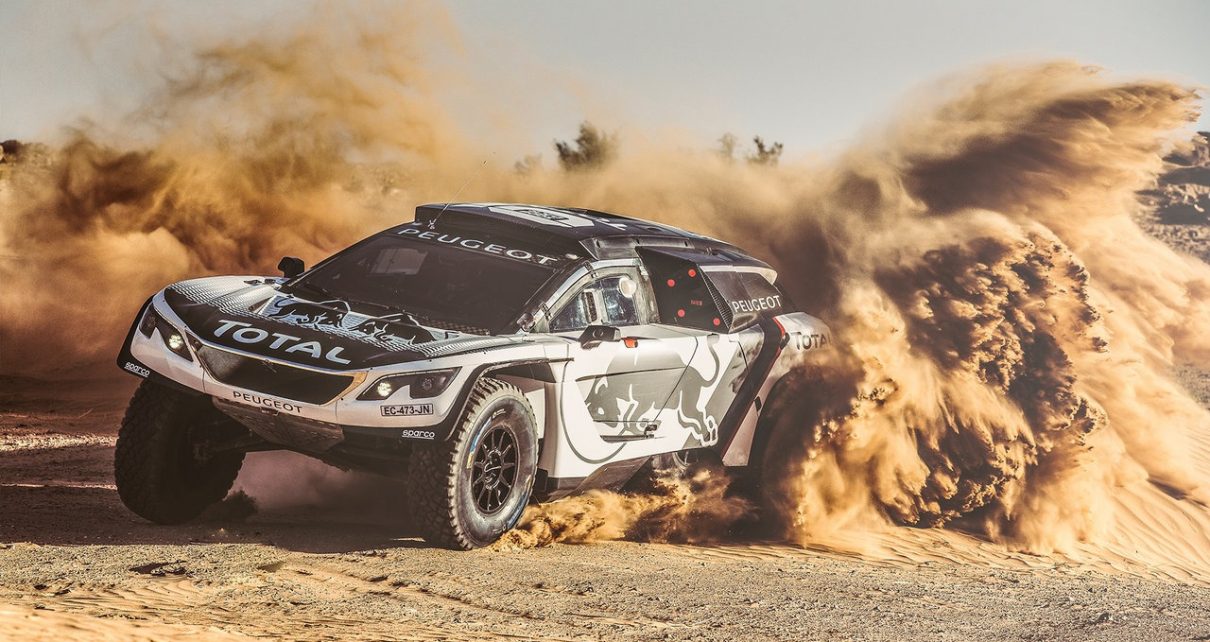

Before we get into technical details, it’s worth pointing out that the new 3008 DKR has some big shoes to fill; Peugeot dominated the 2016 Dakar raid with its 2008 DKR, with nine stage wins from the likes of Sebastien Loeb, Carlos Sainz and Stephane Peterhansel. In fact, the 2008’s overall victory was the first for a two-wheel-drive car in 15 years.
The new desert raider uses a 3.0-litre twin-turbodiesel V6 producing 340bhp and 800Nm of torque – enough to keep that lightweight carbon fibre chassis hurtling towards its 124mph top speed. A new restrictor on the engine as part of 2017 Dakar regulations means it’s around 20bhp down on the 2008 DKR, but maximum power kicks in earlier and could mean that the 3008 DKR is even faster where it matters than its predecessor. It also sticks with two-wheel drive; Peugeot wants to prove 2016’s win wasn’t a fluke, and that you don’t need four driven wheels to tackle some of the planet’s most inhospitable climates.Another crucial tweak is to the suspension. Without a state-of-the-art set-up, the 3008 DKR will be left floundering on the leaderboard, so its geometry and dampers have been refined and a test programme taking in the gruelling 15-day Silk Way Rally should mean the car can tackle the worst of the Dakar.
Reliability and driveability have also been worked on. “Our goal was to take the weaker points of the existing car and make them stronger,” said Peugeot Sport’s team director Bruno Famin, “capitalising on all the existing strengths to improve them still further.”Peugeot Sport engineers strengthened and refined the chassis and fine-tuned the electrical systems to make sure the DKR monster remains infallible on any terrain. The air-con has had an overhaul, as it must cool drivers for up to 12 hours as temperatures outside pass 60 degrees Celsius.For 2017, the event twists through Argentina, Bolivia and Paraguay. Peugeot is eyeing its sixth Dakar win, and the 3008 DKR is a good bet for glory.