
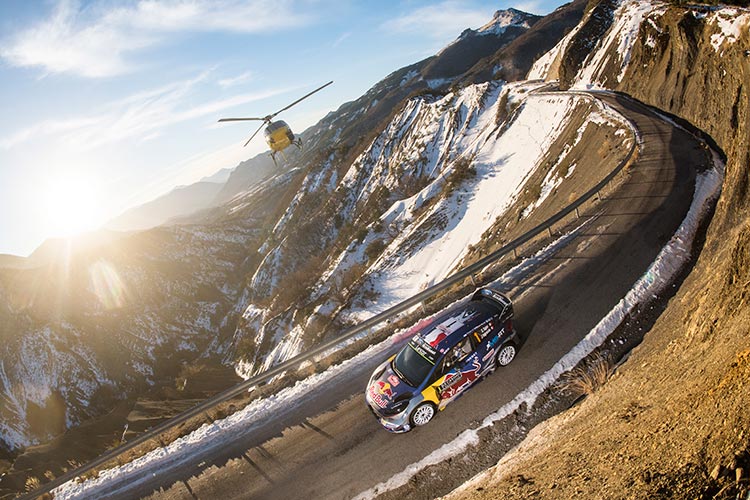
It’s hard to describe Rallye Monte-Carlo without straying into the realms of cliché, but that’s perhaps understandable considering how long this event has been a fixture, indeed the opening fixture, of the FIA World Rally Championship calendar. Steeped in both prestige and history, the Monte has long been defined by the dreaded tyre lottery, and the ability of drivers to fight at the top largely rests on the decisions they make back at Parc Ferme.
Credit: Jaanus Ree/Red Bull Content Pool
The need to pick and run with a particular compound of tyre means that crews must drive within their limits, well aware that what works brilliantly at the bottom of the col is likely to be ill-suited to conditions at the top.
The specialised nature of of the rally tends to divide opinion between those crews taking part, and it’s relatively rare to find a driver merely indifferent to it – most tend to either love or loath the Monte. Succeeding here forces crews to drive in a highly cerebral manner, maximising those stages well suited to the tyres they happen to be on at the time, while taking care not to hemorrhage time on those which aren’t. This year looks to have presented the crews with an even steeper challenge than usual, with an especially blanket heavy snow coating much of the route. Mastering these innocuous enough looking stages has vexed many a WRC driver over the years, which is explains why experience counts for so much – one need only to look at Sébastian Ogier‘s record to see that.

2018’s running takes in a smattering of classic Monte tests with names sure to make those of a certain age smile and adjust their rose-tinted specs, with opening runs through the 36.6km of Sisteron (run in reverse for the first time) and the 25.4km of Bayons-Breziers, both conducted in the dead of night. Friday brings a tricky trio of tests totaling 150km, with Vitrolles – Oze kicking starting the action, followed by Roussieux – Eygalayes (the longest stage of the day 33.63km) and Vaumeilh – Claret. Saturday sees the rally move North of Gap for 5 further stages, Agnières-en-Dévoluy – Corps and Saint-Léger-les-Mélèzes, and another run through Bayons-Breziers, this time in daylight. The 67.7km of Sunday must be tackled without the aid of a service, while the stages themselves are far from straightforward; La Bollène-Vésubie – Peïra-Cava and La Cabanette – Col de Braus, the second run through the latter forming the Power Stage.

No driver can claim to have truly mastered the Monte Carlo tyre lottery entirely, but some have proved more adept at it than others. Drivers must pick from a heady mix of rubber, including soft compound, super-soft compound, non-studded snow, and for when the going gets really tough, fully studded snow. Each crew is allocated 80 tyres in total for the whole event, increasing the pressure yet further and underscoring the value of experience on the Monte. It’s the ultimate tightrope walking exercise, one conducted against some of the most spectacular scenery the world of motorsport has to offer.