

This time round the event has been moved to Saudi Arabia with the 346 competitors lining up for 12 special stages over 5100 competitive kilometres plus a further 2800 transport kilometres all in 12 days.
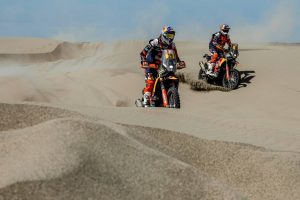
Stage seven will be the longest at 546 kilometres and stage one the shortest at 319 kilometres and there will be a single rest day after six stages.
Australia’s defending champion Toby Price, who also won in 2016, will be joined by Austria’s Matthias Walkner, who won in 2018 and was second last year, plus British rider Sam Sunderland, who won in 2017 and finished third last year.
Sunderland is also the current FIM Cross Country Rallies World Champion so you could say it is a dream team.
Yamaha has won this event nine times and has entered five works bikes headed by Adrien Van Beveran who will be lining for the fifth time and hoping to improve on his previous fourth and sixth places.
Zavier De Soultrait finished seventh last year on his sixth attempt while Franco Caimi was eighth in 2017 and they will be backed up by a couple of rookies.
Honda has won five times but the last time was in 1989 so Kevin Benavides, with a second, a fourth and a fifth, Ricky Brabec, with a ninth and three consecutive failed-to-finish results and Joan Bort Barreda, with a solitary fifth in nine starts, look to be up against it.
There are two works Husqvarnas for Pablo Quintanilla, who scored his second fourth placing last year from seven starts and Andrew Short with a best placed finish of sixth from two starts.
Apart from Price there are four other Australians in the field with Rodney Faggotter on his Yamaha looking to improve on his previous best of 14th in 2013, Ben Young on his KTM with a 51st previously plus rookies Matthew Tisdall and Trevor Colin-Wilson.
There are 85 cars entered with the works Toyota Gazoo Hilux entries aiming to prove that their maiden win in 2019 was no fluke.
Leading the four-car team is Nasser Al-Attiyah who won the event in 2019 and also in 2015 in Mini and 2011 in a VW Toureg as well as second places in 2010 (VW), 2016 (Mini) and 2018 (Toyota).
It should be noted that these cars bear only a passing resemblance to the normal manufacturer’s car and are very heavily modified to cope with the high speeds over incredibly rough terrain.
The Hilux is powered by a 5.0 litre mid-mounted V8 petrol engine with a sequential gearbox and four-wheel drive while the suspension is modified and strengthened to allow for greater clearance and suspension travel.
Giniel De Villiers has finished in all 16 events he has contested with four seconds and three thirds while Bernhard ten Brinke has a best finish of seventh in 2015 from six starts.
All eyes will be on two-time F1 world champion Fernando Alonso making his Dakar debut and adding to his diversity of performances which include winning the LeMans 24-hour sports car race twice and the World Endurance Championship.

His navigator is five-time Dakar winner for KTM and a six-time FIM Cross Country rallies champion Marc Coma whose vast experience will be a major benefit.
The three-car X Raid Mini JCW works entries will be headed by Stephane Peterhansel who has won the Dakar seven times on a motorcycle and seven times in a car from 31 starts.
Backing up “Mr Dakar” will be two-time World Rally Champion Carlos Sainz who won the event in 2010 in a VW Toureg and 2018 in a Peugeot 3008 from 12 starts.
The third member is Orlando Terranova who finished fifth in 2013 and sixth in 2017 from ten starts in cars but prior to that he failed to finish three times in the motorcycle division.
In contrast to the Toyotas, the Minis are diesel-powered and only two-wheel drive so momentum on the sand stages will be key to their performance.
Nani Roma will line up in a Borgward BX7 Evo making its Dakar debut for his 24th start after a 2004 win racking up nine starts on motorcycles before switching to cars.
Former truck division racer for the past ten years Martin Kolemy crashed heavily during a pre-race shakedown and has been airlifted to hospital with back injuries.
source: examiner.com