

Dodgy two-stroke technology and a nauseatingly callous racing establishment were the causes of Monza 1973 – a fiery multiple pile-up that claimed the lives of two of the sport’s biggest stars and changed the course of racing
Motorcycle racing changed forever at 3.17pm on May 20, 1973. The Italian 250cc grand prix had just got underway at Monza and the pack was accelerating flat-out towards the first turn: the daunting, Armco-lined 140mph Curve Grande; no chicane in those days.
German Dieter Braun led the way on his Yamaha TZ250, chased hard by Renzo Pasolini on his Harley-Davidson and Yamaha’s Jarno Saarinen, who had narrowly beaten Pasolini to the previous year’s 250 world title. At that moment Saarinen was the greatest rider in the world and firm favourite for the 1973 500 title after he had dominated the opening two rounds on Yamaha’s first 500 GP bike, the 0W19 inline-four.
As the pack charged through the Curva Grande, Pasolini’s Harley two-stroke seized a piston at about 130mph, locked its rear wheel and hurled him to the ground, where Saarinen was unable to avoid him. The 27-year-old Finn crashed, cannoned into the trackside guardrail and rebounded into the track where he too was run over by the pursuing pack.
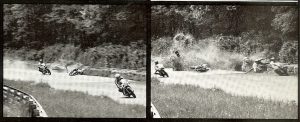
No warning flags were shown and the race wasn’t stopped. Many of the survivors kept racing, threading their way through the chaos
Fuel tanks were ruptured, sparks flew and a ball of fame engulfed the circuit, setting alight the hay bales uselessly lining the Armco. Riders rode through the blinding inferno at high speed, trying but mostly failing to avoid the fallen. In all, 14 riders crashed. Only one or two walked away; several were seriously injured. Saarinen and Pasolini were dead.
And yet in spite of this scene of horror no warning flags were shown and the race wasn’t stopped. For several minutes many of the survivors kept racing, threading their way through the chaos each lap, until they pulled into the pits of their own volition and the race ended.
Two months later bikes raced again at Monza. Before this national meeting, Dr Claudio Costa – later in charge of MotoGP’s Clinica Mobile – asked the organisers to place an ambulance at Curve Grande. His request was refused. Once again there was a pile-up at the corner. It took 20 minutes for an ambulance to get to the scene – too late for the three riders who perished.
Health and safety are usually dirty words these days, but it wasn’t so long ago that race organisers happily got away with jaw-dropping callousness. Monza was by no means the only circuit guilty of such sins.
The people who survived the Saarinen/Pasolini tragedy are still scarred by the events. Briton Chas Mortimer was a top privateer of the time and suffered serious leg injuries in the accident. He still finds it difficult to talk about what happened.
“I was the third person that crashed,” says Mortimer, the only rider to have been victorious in 125, 250, 350 and 500 GPs and F750 races. “I killed Pasolini, actually. There’s a picture of me coming out of the flames with Pasolini lying right across the road and I ran straight into him.
“It was like what happened when Marco Simoncelli was killed (during the 2011 Malaysian GP), except there was no fire at Sepang. That accident really brought Monza back to me – I feel so sorry for Colin Edwards and Valentino Rossi [who were unable to avoid the fallen Simoncelli].
“It was Pasolini and Saarinen and their bikes hitting the barriers and coming back onto the circuit that started it all, then the hay bales caught alight and it was just bloody carnage. I was about the only person that was able to walk away from it. Everyone else was stretchered away. I remember running over see Jarno – all his head had gone virtually – it was bloody horrendous… It was a bloody enormous accident, the biggest there’s ever been in Grand Prix racing.”
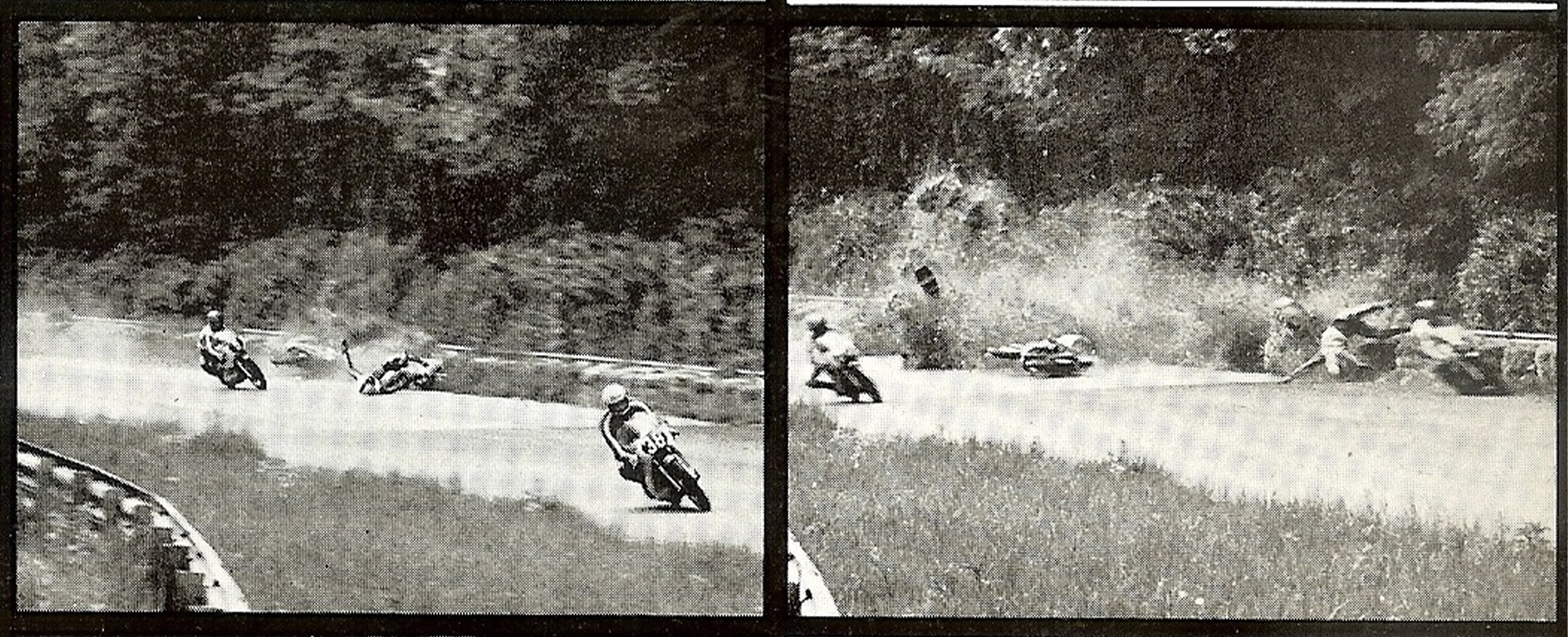
The start of the Monza multiple pile-up that claimed the lives of Saarinen and Pasolini
Yamaha
After the crash Yamaha withdrew its factory team for the rest of the year. An investigation was then established to examine the causes of the accident.
Most people blamed Walter Villa, whose Benelli four-stroke had sprung an oil leak during the preceding 350 race. Several riders had pleaded with the organisers to clean the track before the 250s went out. The organisers refused and then called the police to eject the protesting riders from their office.
Neither Villa – who was one of the 250 fallers and remained in shock and mute for several days after the accident – nor Benelli management proclaimed their innocence, so they were presumed guilty. Thus Villa went to his grave in 2002 without being forgiven by some of Saarinen’s loved ones.
But the investigation found that the accident wasn’t Villa’s fault at all. When Saarinen’s and Pasolini’s machines were stripped the investigators discovered that the Harley’s right-side piston had seized. They concluded that the bike’s rudimentary water-cooling system was to blame.
However, Villa was never publically exonerated because the results of the investigation were never fully published and remained largely unknown until Italian magazine Tuttomoto published them in 1993.
Monza 1973 changed many things, some for the good – it’s been a sad constant in racing that safety improvements are only made after riders pay the highest price for doing what they love. The accident was one of many during the 1960s and 1970s that made riders realise they were being taken for a ride. Something had to be done to improve safety.
“As long as tracks like Monza are used, the rider’s life isn’t worth more than that of a mouse in a mousetrap – nothing,” said Braun after that fateful day
Blame it on the ‘death rails’
Although a flaky two-stroke caused the Monza pile-up the accident might not have proved fatal if the circuit hadn’t been ringed by Armco. Both Saarinen and Pasolini died after they hit the guardrail and bounced back into the oncoming traffic.
Thus two big lessons were learned: the bike builders needed to improve lubrication, metallurgy and cooling, while the track builders needed to get rid of the Armco,
“The riders called the barriers ‘death rails and at that time they were rising like mushrooms out of the ground at every circuit,” recalls famed Yamaha mechanic Ferry Brouwer.
Source: motorsportmagazine