
This is a series I will write for the subscribers to the Rallystar website – it will cover the development and progress (in most cases) of the art of navigating over the past 12 or so years up to the end of 2014 when a new system was introduced in South Africa and my involvement in the sport was ended by the so called Rally Commission or something to that effect.
In order to get to most of the important things around navigation, this series will probably cover all aspects of the sport, such as the importance of the combination or let’s rather say the synchronisation between driver and navigator. The emphasis will however be on the role of the navigator.
We will also look at some problems with the making pace notes, what to look for and why – for instance when the rally runs over the same stages twice.
Episodes of this series will be published once a week and I will try to cover as many as possible of the problems experienced by teams.
I hope you will enjoy this series and that it will help you to understand the game better even if you never get into that hottest of hot seats next to a petrol-head.
PART 1
WHAT IS A GOOD NAVIGATOR WORTH?
Very few people who have not been in a rally car really driven in anger will appreciate what role a good navigator plays in a modern rally car – the interesting part is that many drivers also have no clue.
Not so many years ago navigators in South Africa almost played no role inside rally cars. They had to clock in at control points, help dig the car out when it was stuck, change flat wheels and keep the driver on the route. They did not do much navigation compared to the modern navigator and in many cases they landed the job because they contributed towards the cost of running the rally cars. Best friends and family often made up teams.
Navigation was mostly restricted to two to five calls per kilometer and then they still cocked it up sometimes and did indeed believe that they worked very hard.
Regularity rallies was a bit more complicated as the driver had to drive at exactly the right speed and arrive at control points at specific times or be penalised. The speeds were regulated by the legal road speed limits, but the trick was to “stretch” the kilometres so much that no matter how hard someone drove, drivers could simply not make the allowed time between points and the driver with the least lateness was declared the winner. Rally cars shared public roads with private cars and most rallies were run at night giving the driver some sort of chance to see the approaching lights of other road users. Early morning close shaves with school busses and Mom’s Taxis were not exceptional.
Drivers did not find it awkward to hear instructions such as “3,15 km turn sharp left”. This meant that that 3.15 kms filled with corners and obstacles were the drivers problem and he or she had to drive what they could see.
The navigator then counted the driver down from 500m or only from 200 or 300m depending on what the driver wanted.
In all honesty – almost anyone could navigate – some better than other but the levels were not too far apart.
Many drivers like me for instance preferred a navigator not to say too much and never too soon.
My rule was simple – “keep quiet until we are 200m from anything and start counting down from 300m if we were travelling in 6th.”
The reasons why I preferred “quiet” navigators was that drivers in those days – up to 2002 in South Africa had to concentrate so hard on reading the road and predicting or maybe guessing where and how sharp the next corner would be, that the navigator was more a disturbing factor than anything else. Some drivers – including me, seemed to hesitate or lift the right foot slightly every time the navigator opened his mouth. The reason for that was that you did not get combination calls – something like “Crest (blindrise) and turn Right 6” that gave you an immediate indication of what to expect on the other side of the Crest. All you got was a warning of a crest with a corner to the right or left – don’t get me wrong – in many cases you had no idea what happened on the other side of the crest! The only instructions we received on many rallies were the turn off’s from the road you were on.
This “habit” did cause some major accidents – I recall Geoff Mortimer and the late Spotti Woodhead going straight down a mountain after they “thought” they were going over a crest with a nice straight after it.
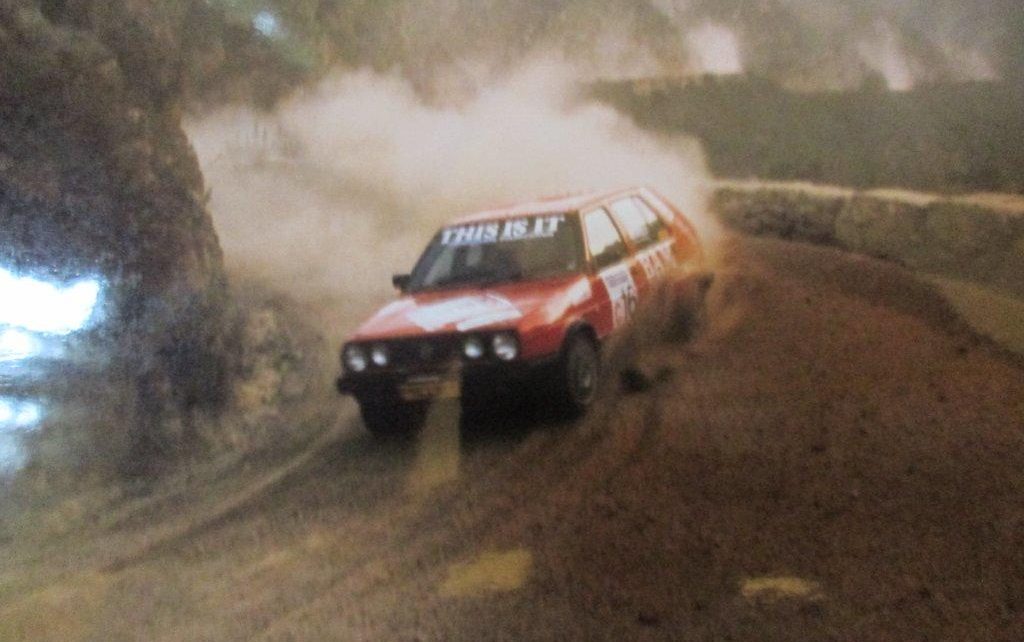
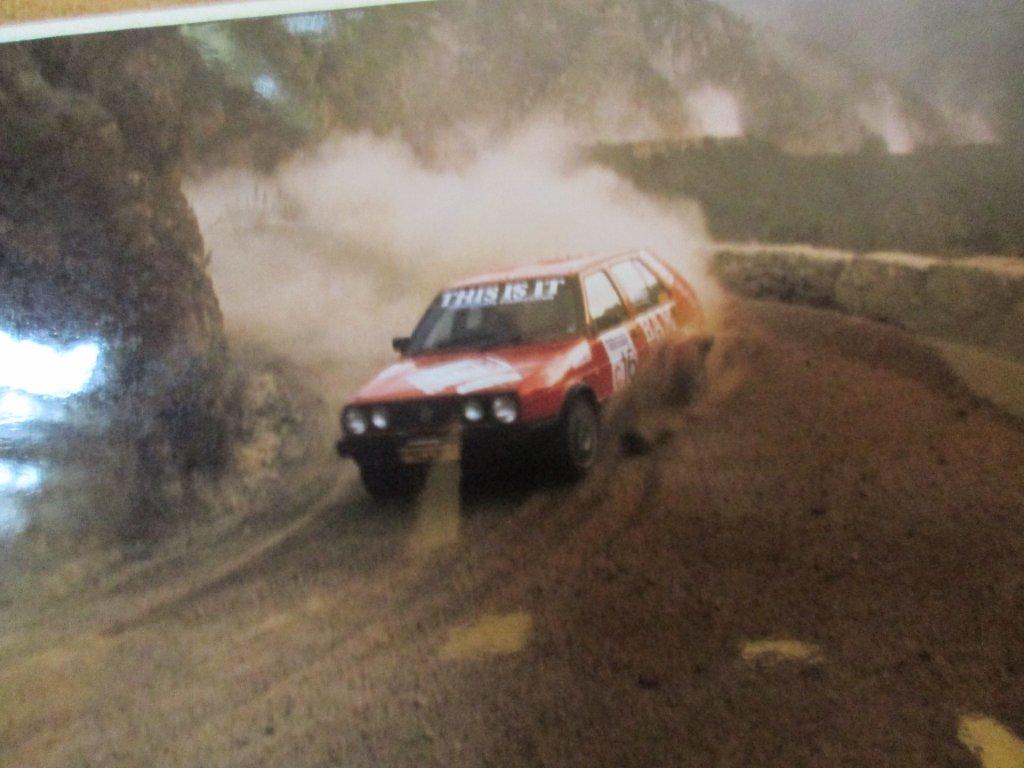
Francois Jordaan and I came over a crest so hard once that we went over a few spectators who dived for cover, before we went straight down into a plantation. We missed everything – including the trees, turned around went up the bank and the almost dead spectators helped us over the final meter or so back onto the road. We still posted third fastest overall time in “that red Pizza Hut Golf” – I still miss that car (although the car was actually a few different ones painted in the same Pizza Hut red!)
I will never forget when Jan Hettema said after the Duckhams Rally of 1973, if I recall correctly, that navigators were “expendable” – we almost had the first strike in South Africa on our hands.
He was unpopular for making that statement but it was actually very true. Navigators did not really have that much to do with the success in the car except if they were really bad!
A navigator of mine fell asleep in a stage once while we were leading the Group 1 class.
There was one problem though – some of the so called “works teams” and a few well settled cliques had “pace notes “ of almost all the stages we used in the country.
Alliwal North was the favourite holiday spot for certain drivers and they could not get enough of driving over the same route over public roads we used year after year through the treacherous mountain passes in that area.
The Cape stages were visited frequently by certain teams who went to drink coffee about four times a weekend with the same farmers who were often not even at home.
Well “established” drivers in Natal could actually tell you in which gear to take notorious corners – every second corner on that event was notorious.
The plantations in the Eastern Transvaal were all very well plotted by connected drivers and in short – the non-favourites who were not in the cliques, the upcoming and the novices – no matter how much talent they had, did not have a fair chance. “Pace note searches” never revealed much as the works teams had radios instead of cell phones those days and there was not a single pace-note to be found anywhere in a car – well not that we knew of.
Next time – PART TWO “MOVING TOWARDS A NEW NEW ERA”
© all rights and copy rights held by the author Leon Botha 2015 and onwards.