
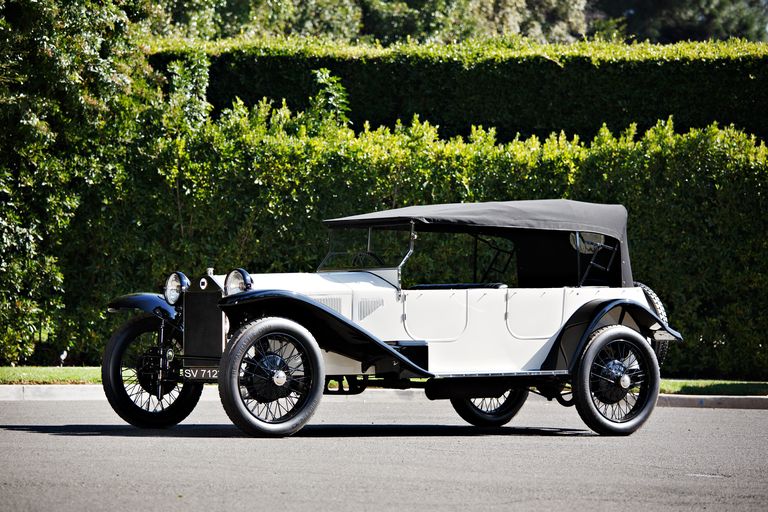
This 1925 Lancia Lambda Series 5 Torpédo, headed for Gooding & Co.’s upcoming Scottsdale, Arizona, auction, is a good example of a car Young Graham would have basically ignored. It lacks the sheer presence and grandeur of the prewar American classics that captivated me as a kid, and it’s not as stylish and fun as a postwar sports car or cruiser. There’s no wild streamlining, fancy one-off coachbuilt bodywork or ostentatious chrome. It doesn’t pack a monstrous V12 or V16 or a snarling eight-cylinder. A casual glance reveals nothing more here than a fairly generic-looking, borderline fussy old car.

Consider: The Lambda packed an interesting narrow-angle single overhead cam V4 engine and came equipped with four standard drum brakes. A four-speed transmission was added to the mix beginning with Series 5 cars (like this auction-bound example) beginning in 1925. It had independent sliding pillar-style front suspension—not the first car to be so equipped, but probably the first truly successful model with IFS.
And, most importantly, the Lambda is the first production car to use what we would consider a monocoque chassis/body construction method. There’s no ladder frame underneath this car; body panels are attached directly to a metal skeleton structure, becoming an integral part of its structure. This makes the car both light and rigid, even though the Torpédo variants had no fixed top.

Lancia’s drive to produce lighter, stiffer, nimbler cars powered by advanced, small-displacement engines is a mission that sounds modern today, and it’s especially shocking when you consider what was going on in America at the time. It was in 1925, for example, that Buick—which, to its credit, had been quick to adopt relatively advanced tech like overhead valves while others stuck with flatheads—decided to kill off its own straight-four engines in favor of an all-six-cylinder lineup. The bigger-is-better mentality was already in place; to this very day, the average American car buyer hasn’t managed to shake that mindset (and to be fair, the rest of the motoring world is doing its best to keep up).
Though the Lambda wasn’t a flop, one of its defining features may have been a little too advanced for the market. One disadvantage of the forward-looking monocoque approach was that it makes it well nigh impossible to fit the car with a custom body (this helps explain why there’s no coachbuilding industry to speak of today). And so, beginning with Series 6 cars, Lancia began offering prospective Lambda customers the option of a bare chassis. If it were a logical concession to consumer taste, it was also one that compromised the original Lambda vision.
By the time the ninth series rolled around in 1931, only bare chassis were offered. This means that, oddly, the last Lancia Lambdas produced were—at least where the body was concerned—less advanced than the very first Lambdas build in 1922, yet more evidence that technological development doesn’t necessarily always move in a straight line.
Source: Autoweek