
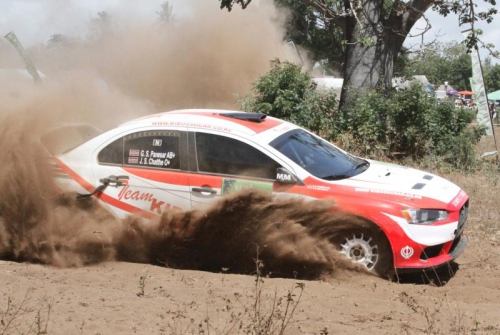
Thirty-five-year-old Kisumu-based Jaspreet Singh Chatthe navigated by Gugu Panesar in a Mitsubishi Lancer Evolution has entered his name in the annals of Kenyan motorsports history after winning the 63rd Safari Rally which ended in Meru county yesterday. Yesterday’s feat was Chatthe’s third career win after clinching ARC round of Tanzania and Nanyuki Rally last year.
Chatthe, who is being serviced by the MML Sport from the UK, achieved the feat with a fierce battle with Ian Duncan in the last two stages around Kibirichia and Meru Forest. And Chatthe had his campaign effectively sewn up when leader Tapio Laukkanen retired following a service error, which saw his crew fail to arrive at the Loldaiga pit stop for remote service in time.
The victory earns Chatthe the title of the fourth “Flying Singh” after the legendary Joginder Singh, Sarbi Rai and Baldev Chager who won two back to back Safaris in 2013 and 2014. Second overall was Ian Duncan, who on his maiden outing with a Liquid Telecom EVOX, lost the Safari by a mere 13 seconds. Duncan, who has won the Safari only once in 1994 when it counted towards the World Rally Championship (WRC), failed to break the 21-year jinx and watched helplessly as the title slid through his fingers for the umpteenth time. “I gave my all in the last two stages but still found Chatthe going quicker,” said Duncan.
Carl “Flash” Tundo, in a Proton Neo Satria S2000, settled for third position. Fourth was Baldev Chager, who failed in his attempt to clinch a hat-trick of Safari wins. Fifth position went to Manvir Baryan in a Ford Fiesta R5, which is the newest make to make way onto Kenyan stages. The three day event was characterised by muddy conditions which rekindled the olden days when Easter Holidays pulled together world beaters in the battle between man and machine.
The most challenging aspect though for crews this time round were the long transport road sections, which prompted organisers to introduce remote service zones.