
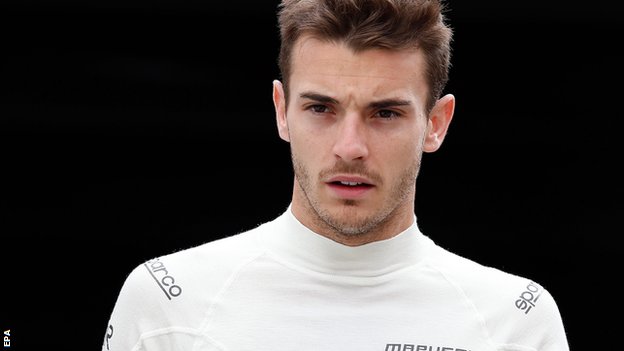
A 10-man accident panel was commissioned by the FIA to investigate the accident that hospitalised Bianchi with life threatening head injuries in October. It revealed its findings at a meeting of its World Motor Sport Council on Wednesday.

Bianchi reports calls for yellow-flag speed limits in all racing
The report disclosed more details of the circumstances surrounding Bianchi’s crash in Japan, in which he careered into a mobile crane while it recovered Adrian Sutil‘s crashed Sauber.
The report reveals that the brake-by-wire system on Bianchi’s Marussia was “incompatible” with a fail-safe system on F1 cars, which is designed to cut the engine when the driver applies brakes and throttle at the same time.
It says this “may have affected” the speed at which Bianchi struck the crane.
The report said: “During the two seconds Bianchi’s car was leaving the track and traversing the run-off area, he applied both throttle and brake together, using both feet.
“The FailSafe algorithm is designed to over-ride the throttle and cut the engine, but [this] was inhibited by the torque coordinator, which controls the rear brake-by-wire system.
“Bianchi’s Marussia has a unique design of BBW, which proved to be incompatible with the FailSafe settings.
“The fact that the FailSafe did not disqualify the engine torque requested by the driver may have affected the impact velocity; it has not been possible to reliably quantify this.
“However, it may be that Bianchi was distracted by what was happening and the fact that his front wheels had locked, and been unable to steer the car such that it missed the crane.
“Bianchi’s helmet struck the sloping underside of the crane. The magnitude of the blow and the glancing nature of it caused massive head deceleration and angular acceleration, leading to his severe injuries.”
The report also says race director Charlie Whiting was correct not to call for a safety car while marshals dealt with Sutil’s initial accident.
“The actions taken following Sutil’s accident were consistent with the regulations, and their interpretation following 384 incidents in the preceding eight years,” the report added.
“Without the benefit of hindsight, there is no apparent reason why the safety car should have been deployed either before or after Sutil’s accident.”