

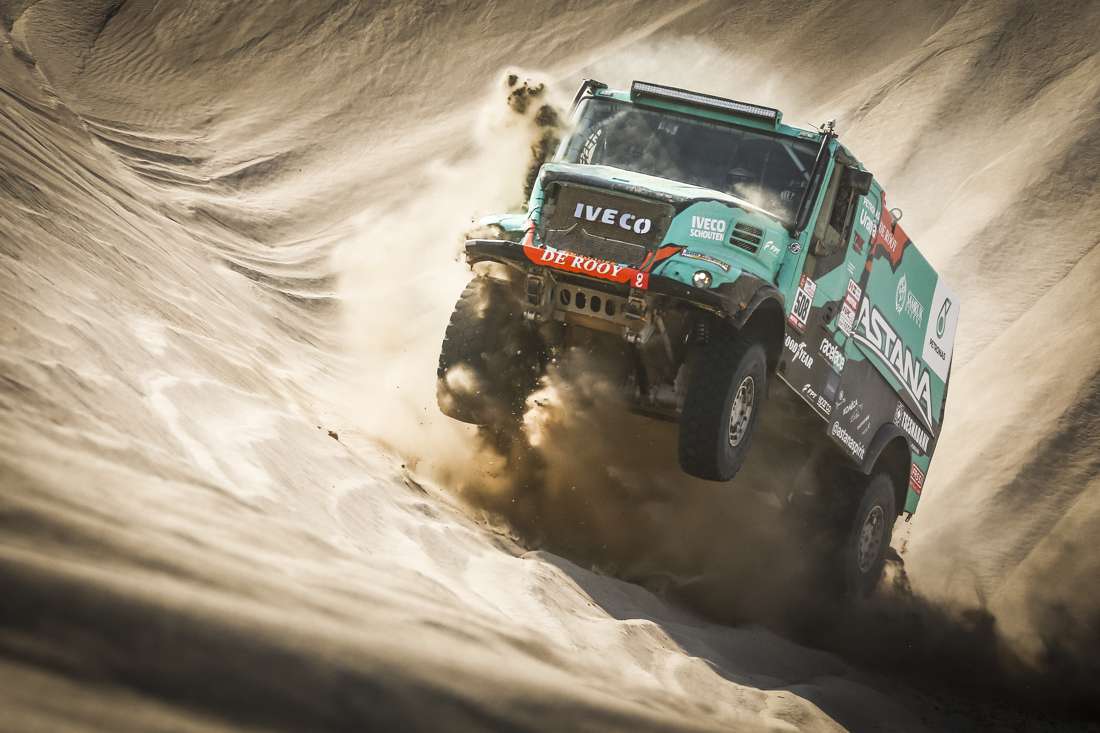
The domination of the Kamaz team continued in 2018 with the third victory for Eduard Nikolaev, despite the unsuccessful attacks of Fernando Villagra.But among the 41 trucks expected at the start in Lima, Team De Rooy will be stronger with the return of Gerard De Roy to the Dakar.
The photo of the Córdoba podium last January had a “déjà vu” feeling about it, and for a good reason. Eduard Nikolaev had just won his second consecutive Dakar, and third overall in a category massively dominated by Kamaz with 15 titles in 22 years (8/10 in South America). The collective Russian celebration, with drivers tossed into the air and the deployment of the nation’s flag, was nevertheless a relief after a huge scare in the waning days of the rally.
Following a pause in 2018, two-time truck class winner Gerard De Rooy (2012 and 2016) returns with lofty ambitions. And in addition to his Argentinean partner in crime, the boss will also be able to count on Ton van Genugten, who is now a serious threat after winning four stages on the last Dakar.
The most direct threat is therefore clearly identified for Kamaz, where we also have to observe in detail a densification of competition at the highest level. In the 2018 general classification, it was their Belarussian “cousins” from Maz who followed Nikolaev, with Siarhey Viazovich on the second step of the podium at a reasonable distance of four hours. But appetites have continued to grow in the meantime, with 29-year-old Martin Macik (Big Shock Racing), who represents the future of the discipline and who intends to continue to improve after finishing in the Top 5 for the first time in 2018.
In the future, this may be Ford’s goal, which is making its debut as a factory constructor with two trucks, entrusted to Belgian drivers Peter Van Delm and Yves Rutten. In the meantime, they could give the Sugawara family run Hino a run for its money in the under 10-litre class.