
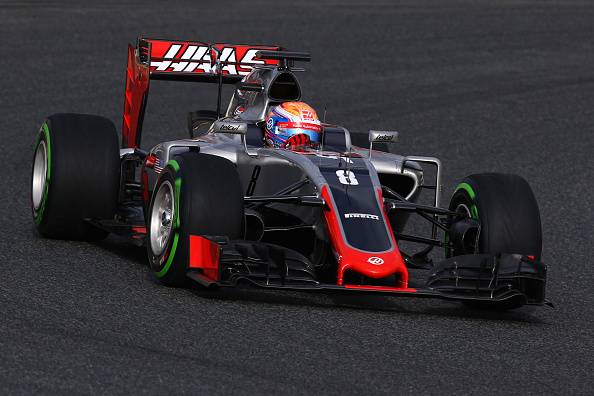
Anyone who has seen the Haas F1 team in action in Barcelona this week will concur that this is the best prepared new team to enter the sport since Toyota 15 years ago.The team has started well. They will continue to be closely watched in their debut season, because if their model works of buying everything legally available within the F1 rules from a top team and going racing for around $100m a season, then other wealthy business owners, keen to capitalise on F1’s global platform, will follow.

Haas has been talking about entering the sport for five seasons and took an extra year to prepare when it realised that 2015 might be rushing things. That extra year has made all the difference. The team has developed a good car with Ferrari and Dallara, hired sensible drivers and employed good people in all areas. There is no sense of panic or rush around the team. They almost look as though they are enjoying themselves.
Contrast that with the toil and tears around the Class of 2010 new teams; Marussia, HRT and Caterham.
And it is not just the rich wannabe team owners, searching for a sustainable F1 business model, that will pay attention. The top teams will be all over it; they are looking to generate a profit centre from a customer collaboration as well as to consolidate a political ally and their crucial vote in the F1 commission.
With the political temperature rising between the FIA, CVC and Bernie Ecclestone on one side and the manufacturers on the other, this model could offer the best way for the manufacturers to get a political stranglehold on the sport ahead of the new Concorde Agreement negotiations post 2020.
Ecclestone described the manufacturers’ relationship with their engine customers as an ‘illegal cartel’ last week, but that is nothing compared to the closeness collaborator teams would feel with their ‘parent’ in a Haas-model relationship.
It’s also enough to threaten a breakaway, if the manufacturers want to push Ecclestone to the limit in the 2020 Concorde negotiations.

“If we are successful my guess is that people will imitate us,” team owner Gene Haas told F1.com this weekend. “Probably some bigger teams do want to have a smaller team. You are only allowed to run two cars and having two more cars that you are associated with – maybe that gives them some sort of advantage. Maybe that would be good for the sport. Maybe what will happen with us as role model is that probably one side will be laughing and the other side crying. So let’s wait and see.
“I think everybody is so used to [self manufacturing] here – it’s probably ingrained in their way of doing things. We never had that. We want to race cars and not get too much involved with production,” he adds.
“I do respect the F1 guys, but ultimately when you come to a race I don’t think people know the difference between a self-produced transmission and a purchased transmission. I don’t think that they care.”

Success, for Haas, does not necessarily mean winning in F1; it means competing meaningfully, having a strong and sustainable relationship with Ferrari and using F1 to sell Haas Automotion products around the world, scaling the business up three to five fold from where it is today. For a spend of $100m a season, that’s a model many will be willing to explore seriously.
There are others around the sport, like Tommy Hilfiger founder Lawrence Stroll, who have the funds to go racing this way. He has kicked the tyres on Toro Rosso and Sauber as well as Marussia (now Manor) without committing.
He has a son, Lance, who’s racing in FIA F3 this season and they have formed an alliance with Williams, whereby Lance is going to do thousands of miles testing in a 2014 Williams-Mercedes (permitted in the F1 rules) as a prelude to an F1 entry in the next couple of years.
For Stroll, the priority is to get Lance into a team capable of racing at the front and strategically they see Williams as a good development ground, rather than running their own team using a Haas model. Long term, Stroll may well be lining up to acquire Williams, post Sir Frank, which is a logical move.
But others, who perhaps do not have the ‘racing son’ dynamic to accommodate, might see team ownership on a Haas model as a winner.
Force India, post Vijay Mallya and under Diageo ownership, may well look to do something similar with Mercedes. They pioneered the idea of buying gearboxes and limited other parts, beyond engines, from a top team.
Haas has come in and moved the model on to the limit of what is possible, and it looks mighty attractive on many levels right now.