
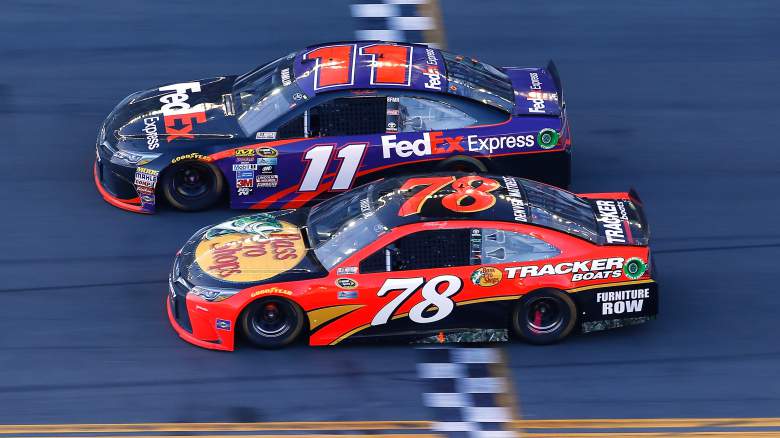
The official margin of victory is .0010 seconds, a figure that was rounded down from .0011, which was the number that the electronic implements that calculate such things produced on its first pass at estimating the space between Denny Hamlin’s victory and Martin Truex’s loss in Sunday’s 58th running of the Daytona 500.
That’s the finest victory since computers have been keeping score. That’s three times faster than the blink of an eye, hardly quick enough to take in Hamlin as he nudged his black Joe Gibbs machine inches ahead of Truex’s Furniture Row car on the final laps of a race that was long on dramatic twists.
Most who saw that photo finish live will be forgiven for thinking that Truex was the victor. That includes the New Jersey boy himself, who was fairly convinced that his positioning on the low line of the track would prove his E-Z Pass to Victory Lane. “I knew it was really close,” he said. “I just said [to myself], ‘Damn, that was close.’ [I] tried to look at the big screen, as you do. My spotter was going absolutely ballistic on the radio, screaming. I couldn’t tell what the heck was going on. [We] did our best to beat him at the line, but just came up short.”
Racing
Video
Daytona 500 blog: Denny Hamlin wins a close one
by Andrew Lawrence
While Truex did not get the ending he had hoped, the final act he co-authored with Hamlin transformed NASCAR’s premier event into a certified blockbuster—and in its very first show following a massive renovation to their grandest stage, no less. Keep in mind: this was a result achieved without any fettling from the Cup series’ myriad new rules for the upcoming season, making it something for the sport’s many hardline fans to truly savor. What’s more, this conclusion drew a massive general audience without a bankable star in a headlining role. The retired Jeff Gordon watched from the FOX booth, the retiring Tony Stewart joined the broadcast via phone and Dale Earnhardt Jr. spiraled out of the race after botching a drafting move in the middle of the pack. Surely NASCAR’s corporate stewards are pinching themselves, still.
This year the Great American Race made itself. How did this come to be? Hamlin still can’t quite explain it. “It just all happened so quickly,” he said. “Usually in these things, you’re leading with five laps to go. And usually whoever’s leading wins the race. You have time to think about it. You’re getting emotional while you’re still racing. For me, I was so caught in the moment. And when we won the race, it was like, OK, now what just happened?”
As with most automotive mysteries, it’s best to start under the hood. Those tens of thousandths of a second might belong to Hamlin but, let’s be clear, the day belonged to Toyota Racing Development. Celebrating its 10th year in NASCAR, the manufacturer’s imprimatur was all over this contest, “the single biggest race in our company’s history,” according to TRD majordomo David Wilson.
Among the modest number of franchises TRD counts among its partners is Joe Gibbs Racing, the four-car superteam that would chaperon the company into stock car racing; and Furniture Row, its splash free-agent signing of the 2016 season. The idea that Furniture Row would abandon Chevrolet, the motorsports overdog that carried Truex all the way to the final round of the 2015 Chase, for a manufacturer that Gibbs drivers didn’t hesitate to publicly savage just a year and a half ago speaks to the strides TRD has made in improving the power and reliability of its engines. “It’s taken time for us to collectively build an organization with our team partners that is capable of winning races and competing for championships,” Wilson added.
Racing
Video
Burning desire: Kyle Busch stamps himself as one of racing’s best
by Andrew Lawrence
The improvement was obvious last year, as the Gibbs team won a staggering 14 races and Kyle Busch rallied from a disabling accident in the 2015 500 to win the Sprint Cup championship. That hot streak carried into Daytona, where Toyota cars topped the leader boards in preamble races (Hamlin won the Sprint Unlimited, and Busch triumphed in the second Can-Am duel) and in the practice sessions during the week leading up to Sunday’s feature. “We knew in practice a few days ago that our five cars running together ran faster than the pack,” Hamlin said. “And I was thinking, ‘Man, why don’t we just stay in line, run the bottom; no one should be able to pass us.’”
Restrictor plate races have a way of bringing out a collaborative spirit among competitors. The nature of the competition—which, by capping engine power, makes a far greater game of slipstreaming—all but demands that cars work together to build momentum. This organizes the grid into small confederations that are built upon, well, all sorts of things: driving habits, pit positioning, speedway experience. When big franchises can’t band together, they join up with smaller ones. When one driver can’t get ahead, he pushes the one in front of him, hoping their magnetic energy turns into pure magic.