
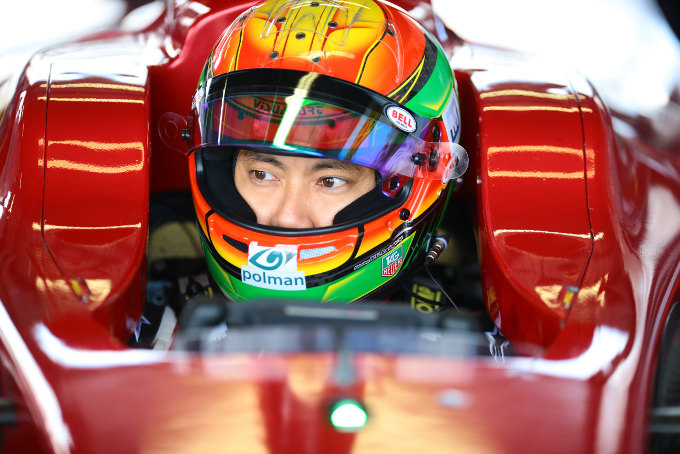
There might be over 1.3 billion people in China, but only a handful of them are racing drivers. There’s never been a Chinese driver in Formula 1, although Ho-Pin Tung did spend two season’s as an official reserve at Renault/Lotus.
The main reason for the lack of top line Chinese drivers is because motorsport in China is still very much in its infancy. And indeed Tung, who’s half-Dutch, began his career racing go-karts in Europe. It was only when he moved up the ladder to single-seater racing – in his case Formula BMW – that he started competing in Asia.
“Racing was just purely a passion,” says Tung, who will be representing China Racing in Formula E. “I started go-karts just for fun. Because there was no background in the family no one had any knowledge about it. So I think that’s the reason I started relatively late – I was 14 years old when I first stepped into a proper go-kart. You can compare that to today where kids of 17 are going into Formula 1!”
Demonstrating a natural flair for karting brought him to the attention of the wider motorsport scene in the Netherlands, and victory in a talent scouting competition was rewarded with a season of Formula Ford racing. Having adapted well to the step-up, the decision was made to move to Shanghai in China, and to compete in the inaugural Formula BMW Asia series.
It proved to be an inspired choice. Teaming up with the crack Meritus outfit, Tung won the championship and earned himself a Formula 1 test with the Williams team at Jerez in Spain. Stepping from the 140bhp Formula BMW car to the V10 F1 beast with around 850bhp was a huge leap, but one he’ll never forget.
“I was very inexperienced, obviously, but I was relatively well prepared also,” he says. “I had a lot of help and support from the people around me who managed to prepare me physically and mentally as well, because it was a big jump. I remember the team being extremely helpful and making me comfortable. Marc Gene and Juan Pablo Montoya were there at the time as well and it was a very pleasant experience and a great memory.”
With the V10 still ringing in his ears, Tung moved back to Europe to compete in the German F3 series. While the likes of Paul di Resta and Sebastian Vettel with duelling for the Euroseries title, Tung was defeating Nico Hulkenberg for the German championship, something he achieved in a Lola rather than the numerically superior Dallara.
Around this time a new series called A1GP had started. It was a unique concept that pitted nation against nation, and it brought Tung to the attention of Team China – the same team he’s driving for in Formula E. Initially clashing commitments meant he was unable to take part, but he grabbed his opportunity with both hands when it arose by scoring the team’s first podium finish in the Australian race at Eastern Creek.
“Coming from F3 to A1 was a big jump,” he claims, “but it’s nice to see many familiar faces from those times are big names in motorsport now. Guys like Sebastien Buemi, Neel Jani and Hulkenberg.”
The subsequent move up to GP2 failed to yield the expected results. He fared better in Superleague Formula – a motorsport/football hybrid that featured fast, powerful cars in which he took a win at Jarama driving for Galatasaray.
During the winter of 2009 Tung was back in Formula 1 test action, this time with Renault. A reserve driver deal was signed for 2010, which took him back to GP2 with DAMS. However, his season was ended abruptly following a collision with Jules Bianchi in Hungary that left Tung with a broken vertebrae.
“It wasn’t a big shunt, it was one of those unlucky shunts where it wasn’t such a massive crash but the impact was big and I broke one of my vertebrae,” he says. “It ended my season and also disrupted the preparations for the season afterwards so it was a major impact.”
After spending two seasons as a reserve F1 driver but without much opportunity to actually drive, Tung’s career started to stall. He made a last-ditch attempt to qualify for the world-famous Indy 500 race, but crashed and suffered mild concussion.
Since then he’s switched his attention to endurance racing. He’s made two starts in the Le Mans 24 hours and is currently leading the standings in the Asian Le Mans Series.
“When you stand still in motorsport the rest keeps moving along and it’s very difficult to get going again,” he reckons. “I kind of reset my mind and one of the things I really wanted to concentrate on was endurance racing and I think it’s worked out well. This year I’ve done quite a handful of races with OAK Racing and did Le Mans for the second time. It’s been a nice couple of years post-F1.”
Tung was contacted by Formula E to test one of the development cars at Circuit Monteblanco this spring. At the time he didn’t know if there would be the possibility to race, but ahead of the final pre-season test, he received the call from China Racing.
It means his Chinese fans will have the opportunity to cheer him on at their home race, something Tung believes will accelerate the process of establishing motorsport in China.
“It’s one of those countries where the sport just keeps on developing,” he says. “I think in the major cities they have a fast-car culture already, and what you are seeing now is this start to spread through to the second- and third-tier cities. The general interest in cars is ever increasing.
“I think the Chinese motorsport federation plays a very important role in promoting the sport in China and they’ve been very active in the beginners’ level. We have a very talented go-kart driver at the moment called Guanyu Zhou, who’s just signed for the Ferrari driver academy. There’s a very strong local touring car championship, the CTCC. Ma Quinghau is one of the former champions and he recently won a race in WTCC, so I think that shows how motorsport in China is developing. I think having a Formula E race in Beijing around one of the most iconic places in China – the Olympic stadium – is going to help boost the awareness of racing.”