
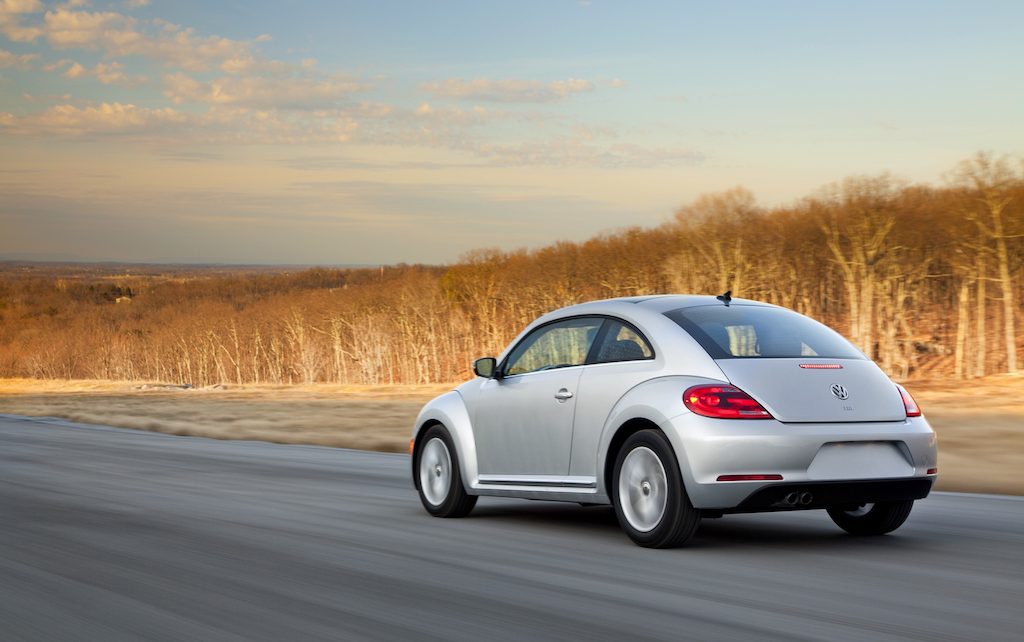

Then Dieselgate happened.
Now, as the company is scrambling to reposition itself in the market and shore up resources to pay the billions of dollars in fines it’s facing, it looks like 2018 could be the end of the line for the Beetle after all. According to a report from Autoline (which broke the cancellation of the Cadillac CT8 last week), the front-engined Beetle will disappear after its 20th year on sale so Volkswagen can focus on crossover models, a segment that the brand feels is key to its survival.
Of course, the current Beetle has virtually nothing in common with Volkswagen’s iconic air-cooled model, but if this report is confirmed, 2018 will mark the first time in the company’s nine-decade history without building a Beetle. The original car, known simply as the Type I (the name Beetle didn’t officially show up in the U.S. until 1970) remained in  production in Germany until 1980, and astonishingly, carried on in Mexico until 2003, after overlapping the New Beetle production for five years.
While this would be sad news for fans of the brand, it’s one of many hard decisions Volkswagen needs to make if it wants to survive. In 2015, the brand sold 131,109 Jettas. In comparison, it sold just 22,667 Beetles. Those numbers will continue to drop as long as the brand’s reputation lingers in the cellar, and while virtually every other automaker is experiencing growth in the U.S. thanks to a ravenous demand for crossovers and SUVs, Volkswagen’s lack of competition in the segments put it at an even bigger disadvantage.

In the aftermath of World War II, the Beetle was a cheap, reliable, and ingeniously engineered compact that put millions on the road and became an unlikely cultural icon in the process. By the ’90s, a generation of people who grew up in a Beetle, learned to drive in one, or had one for their first car were ready to fall in love with a stylish, modern take on the icon. Today, the Beetle is a niche car that awkwardly fits in between the Golf and Jetta, and can’t do anything better than either of them. It’s not a bad car, but it isn’t a great one either, and in light of Volkswagen’s recent troubles, we wouldn’t be surprised if 2018 really was the end of the line.