
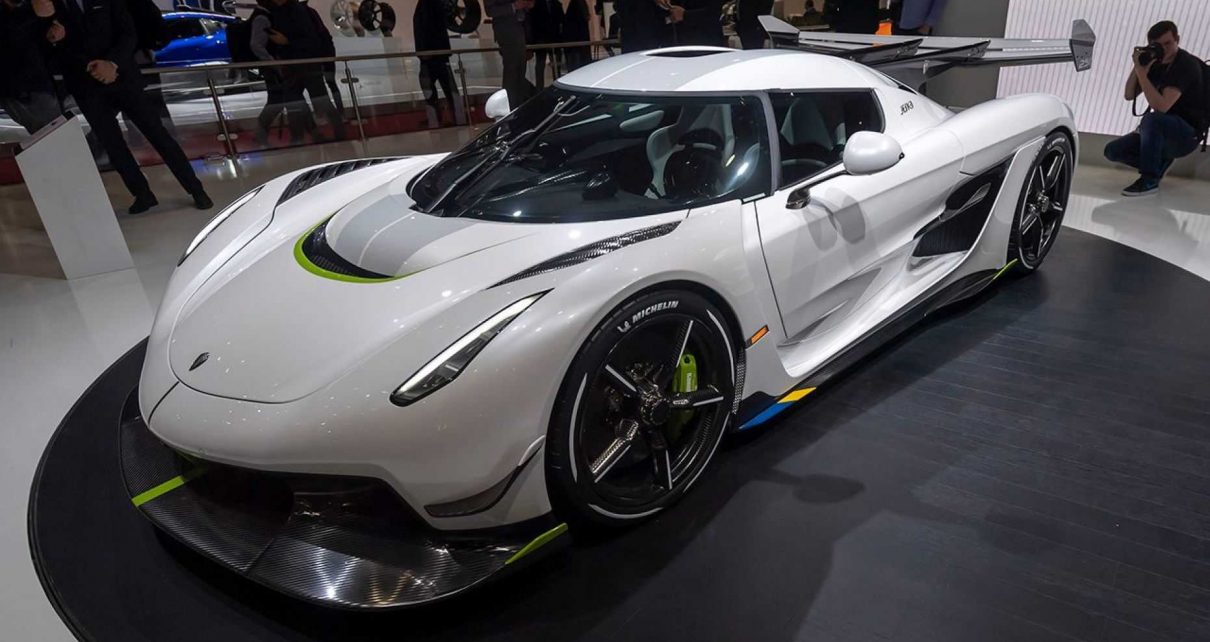

A redesigned monocoque structure composed of carbon fiber around aluminum honeycomb improves head room and leg room, as well as visibility. The dihedral synchro-helix doors, which rotate as they extend outward, have also been redesigned so they open slightly further outward and higher to help prevent scuffs from pesky tall curbs and make getting in and out easier. There’s also premium materials such as leather and Alcantara, while the two seats, which feature carbon fiber shells, are electrically adjustable, as is the steering column and pedal box.
Like all Koenigseggs, the roof of the Jesko can be removed. This time though, the roof features screws for extra rigidity and, unfortunately, there’s no place to store it at the front like with the Agera. Call it a sacrifice to the gods of aerodynamics.

Koenigsegg Jesko
There will be two versions of the Jesko. One is the high-downforce version shown in Geneva, which is claimed to develop more than 3,000 pounds of downforce and is the ideal option for the track. Still in the works is an even faster model. It will feature a smaller splitter and wing, which will reduce downforce but also drag, resulting in a higher top speed. You’ll also be able to store the roof in the front of this model. It’s code-named the Jesko 300, and yes the number refers to the car’s estimated top speed of 300-plus mph.
Controlling weight was another major factor when developing the Jesko; Koenigsegg boasts that the car’s dry weight is only 2,910 pounds. Helping achieve this was the aforementioned carbon monocoque, but also a lightweight body made from a mix of carbon fiber and Kevlar. Carbon fiber also extends to the wheels (aluminum is standard), which measure 20 inches up front and 21 inches at the rear. These are the biggest wheels ever fitted to a Koenigsegg, but they’re also the lightest, weighing 13 pounds each at the front and 16.3 pounds at the rear. Wrapped around each of the wheels are Michelin Pilot Sport Cup 2 tires as standard or Michelin Pilot Sport Cup 2 Rs as an option.
The engine in the Jesko is a new design, though it features the company’s familiar 5.0-liter twin-turbocharged configuration. It boasts four valves per cylinder, double overhead cams, a flat-plane crankshaft, and dry sump lubrication. Peak power of 1,280 horsepower at 7,800 rpm is generated when running regular gasoline but switch to E85 fuel and output increases to 1,600 hp, or 100 more than a Bugatti Chiron. Peak torque is 1,106 pound-feet, generated at 5,100 rpm.

Koenigsegg Jesko
Koenigsegg said it went with the flat-plane crank as the design allowed greater efficiency while achieving a higher 8500-rpm rev limit. The sound of the engine should also be much more menacing, which is a trait of the flat-plane crank. Attention has been paid to saving weight, particularly for the connecting rods and pistons as the engine has a relatively long stroke and a high-revving nature. The pistons also feature a curved face with a special ceramic coating to help prevent knock.
Bigger turbos help achieve the high output, though they usually result in increased lag. To get around this Koenigsegg developed an air injection system that provides a burst of high-pressure air (290 psi) to spool the compressor wheels early. The system relies on a small electric compressor that fills a carbon-fiber 20-liter tank with pressurized air.
Each cylinder of the V-8 features pressure sensors that allow the engine management system to monitor and operate each cylinder from one stroke to another for greater efficiency. This is important for emissions regulations, with the Jesko said to be compliant with standards running out to 2026, including in California. Koenigsegg has added a third fuel injector for each cylinder, as well as a “tumble” valve on the intake side to increase turbulence as air enters the engine, which provides a faster burn rate and leads to greater efficiency. A new heating system to get the catalytic converters at optimal temperatures early also helps increase efficiency.
Another advantage Koenigsegg’s transmission has over DCTs is that it can swap directly between any gear, almost instantaneously. For example, if you’re cruising in seventh gear, and fourth gear is the optimal gear for max acceleration in the moment, the Jesko will let drivers shift down the three gears instantly. This is in contrast to DCTs which need to switch to an adjacent gear.
Koenigsegg will build just 125 Jeskos, and as the car is homologated for worldwide sale, it should arrive at dealerships in the United States eventually. Pricing starts at about $3 million.
Source: Motor Authority