

Now there are four. Audi, Porsche and Toyota are reasonably known quantities for the 83rd 24 Hours of Le Mans on June 13-14 , but into the manufacturer-dominated 2015 LMP1 Hybrid pack, Nissan slips the wildest of wild car(d)s, in the stubby shape of the GTR-LM Nismo.
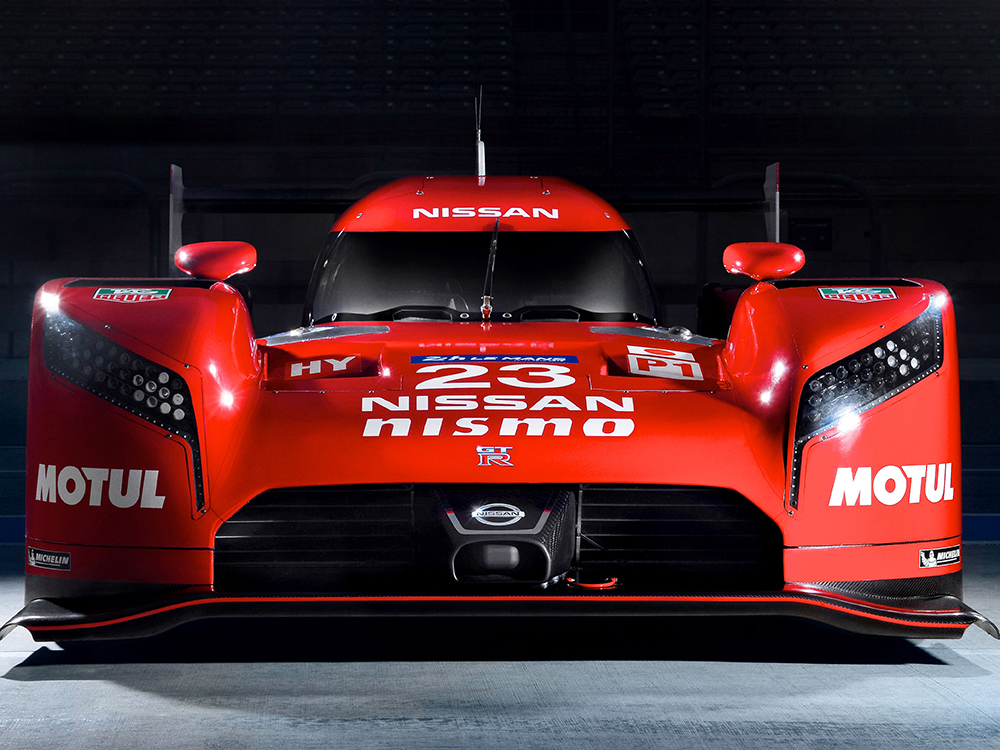
This group, from which the outright winner will emerge, already perms large and small capacity diesel and petrol engines, and battery, flywheel, supercapacitor and exhaust-energy-retrieval hybrid systems, usually with drive to all four wheels. Now, LMP1 returnee Nissan throws in the kind of curve ball made possible only by Le Mans’ uniquely innovation-friendly philosophy – a hybrid with top-side of 1,000bhp, but with its engine in the front and predominantly front-wheel drive.
The three incumbents are, respectively, defending Le Mans champion, all-time Le Mans-win champion/team-most-likely-to-break-through, and reigning World Endurance champion. But while 2015-spec Porsche have indeed beaten Audi to pole in both WEC opening rounds (at Silverstone and Spa), relentlessly reliable and similarly upgraded Audi have again outwitted the rest to win twice, with Toyota looking oddly out of sorts.
The Nissan, meanwhile, has evolved from zero in only 14 months, and as well as being way out on the conceptual limb has had a worryingly short and troubled test programme. But if it works, it would re-write the script, yet again. That’s the back-story.
The first Le Mans Test, on May 31, should have given us a foreword, but didn’t. The two-by-four-hour Test isn’t mandatory, but is essential, so the whole cast was on stage as we waited for preliminary skirmishes. Then the fickle finger pointed at the skies, which chucked the spanner with sporadic and rhythm-breaking rain. Uncharacteristically, Le Mans organiser the ACO then scored an own goal by running one of the mandatory safety-car/slow-zone practices during one of the few near-dry spells during the afternoon session. We’ve often said that the Le Mans rule is “blink and you’ll miss it”, but at the 2015 Test Day you could have popped into town for a meal without much trouble.
It wasn’t exciting, but it was very intriguing. Nissan only completed its third car in the garage after the rest were running, although its team-mates were first on the track. Their up-side didn’t go much further than that, and while they did (as promised) top the speed chart (at 208.8mph/336kph), they were 20sec-plus off the full-lap pace.
In the short, dry periods of each four-hour session, that pace bounced back and forth between Audi and Porsche, by fractions. In the end, cumulatively, it read Porsche, Porsche, Audi, Porsche, Audi, Audi, Toyota, Toyota – with the quickest Nissan 18th. Although, oddly, supposedly race-ready Toyota probably ended with more head-scratching even than toe-in-the-water Nissan.
One theme continues: between 2006 and 2014, responding to ever more stringent fuel regulations, Audi’s winners went ever quicker while cutting consumption by a staggering 38 per cent. Porsche’s record 3m 21.061s Test-topper was quicker than last year’s Toyota pole. Wet or dry, the hybrids look fearsomely quick, and backstage mutterings say the ACO is getting nervous about just how quick. A dirty, slippery track also hinted that there might be three or four seconds to come in qualifying and race.
So, many say Le Mans 2015 could be the fastest ever – if the ACO really does have to rein things in again, maybe the fastest forever. The possibilities just get more fascinating.
From
: The Telegraph UK