
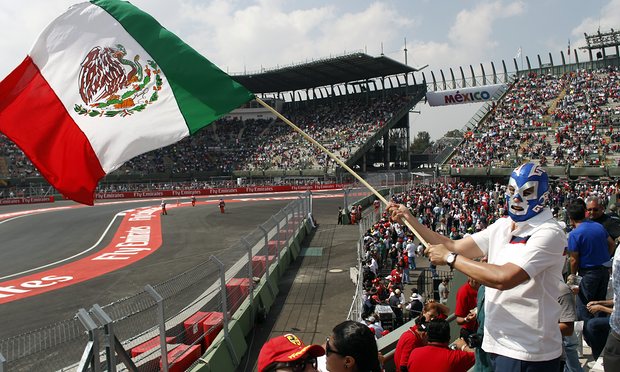
On Wednesday, while the teams were unpacking in the paddock, Mexico City was revelling in their arrival, as well it might. Amid the exaggerated caterwauling of the doom-mongers fearful of dropping attendances and viewing figures, this weekend’s race is part of an almost unparalleled success story from which F1 would do well to learn.
After an absence from the calendar of 23 years, the Mexican Grand Prix returned last year with a bang. That the race was a dead rubber in the championship mattered not a jot to the fans and 134,850 of them packed the Autódromo Hermanos Rodríguez. Only Silverstone could boast a bigger attendance in 2015 and then only by a few thousand. More impressively, the numbers could have been higher. The circuit is located in a public park – limited both by space and by having the equivalent of listed status – so organisers were unable to construct more grandstands.
To put the figures in perspective, the attendance at Bahrain in 2015 was 32,000; in Malaysia 44,611. It is what has happened here in Mexico City in 2016 that really stands out, however. New tracks traditionally suffer a second year drop-off on being added or returning to F1. Austria, for example, had a disastrous 20% fall in 2015 after coming back in 2014. In contrast, Mexico is already 99% sold out again and the numbers are set to be up on last year.
History has its part to play in this passion for F1 – the circuit is named in honour of the brothers Rodríguez. In 1961, in his first race at Monza, Ricardo was the youngest driver to qualify on the front row – a record he held until Max Verstappen bettered him at Spa this year – and raced for Ferrari in 1961 and 1962, taking best finishes of fourth and sixth from six races and a second at Le Mans in 1960. He was killed aged only 20 at his home grand prix in 1962 when the suspension on his Lotus 24 failed on the high-speed banking of the Peraltada – the awe-inspiring and daunting turn now truncated for safety purposes.
His elder brother Pedro was even more successful, winning two grands prix, in South Africa and at Spa during an eight-year career in F1. He also won Le Mans in 1968, one of many victories in sports cars and was acknowledged as a master in the wet. Tragically he too died in an accident, at the Norisring in Nuremberg, in 1971. Both were formidable drivers and are still revered in Mexico, while the interest they engendered in the sport is palpable today.
The presence of two Mexican drivers on the grid – Sergio Pérez and Esteban Gutiérrez is, of course, also a factor, but not one that can be taken for granted. Daniil Kvyat’s presence at Red Bull did not send crowds rocketing in Russia after all. But perhaps most importantly of all is the way the race is being run. It is organised as a public-private venture between the federal government and promoters CIE and they have done so with both care and vision.
“We tried to assess the market to make it interesting for the local people,” Rodrigo Sánchez, the race director of communications, explains. “We also did a survey to try and understand the pricing situation locally and we have proved successful.”