
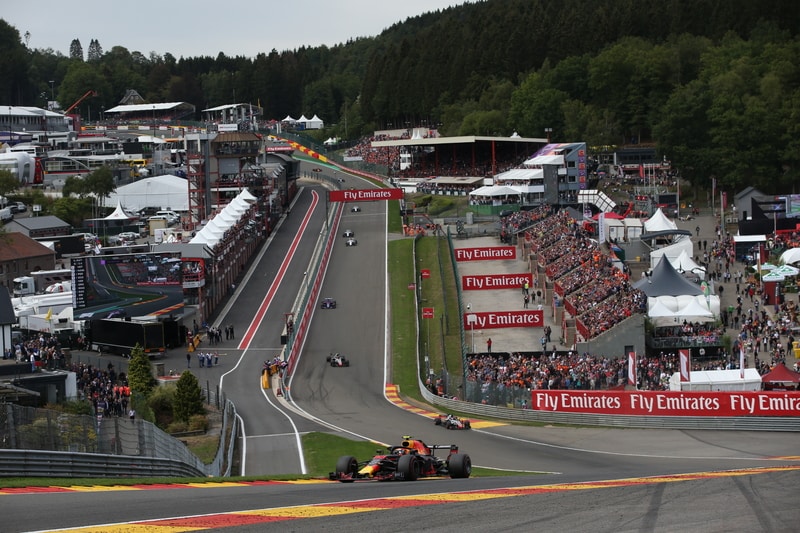
The season resumes with nine races to go at the very traditional Spa-Francorchamps circuit amidst the rustic surroundings of the Belgian Ardennes countryside. This historical circuit is one of the most challenging high-speed, technically demanding circuits on the calendar.
The original track was built using the public roads around the towns of Spa, Malmedy and Stavelot in the 1920s. In 1950, the fifth race of the first Formula 1 World Championship was held at this narrow winding track.
The hilly 14-kilometer route was a high-speed track with quick directional and elevation changes around the fast corners. In the 1960s, major crashes causing injuries and fatalities were common.
In 1966, Jackie Stewart (racing for the BRM team) suffered a high-speed crash that caused him to start a crusade for better safety at all tracks. The lack of safety at the Spa-Francorchamps circuit finally led to the boycott of the Belgian Grand Prix by the drivers in 1969.
After one final race in 1970 at Spa-Francorchamps, the Grand Prix was hosted at the Zolder and Nivelles tracks in Belgium until 1982. In 1983, Formula 1 returned to the modern seven-kilometer long circuit, the longest circuit on the current Formula 1 calendar. The circuit conforms to the contemporary safety standards, but still retains most of the iconic corners of the original circuit.
Alain Prost won the first race on this newly-configured track for the Renault F1 team. From 1985 onwards, the Belgian Grand Prix has always been held at Spa-Francorchamps circuit (except for 2003 and 2006 when the race was not held). The traditional nature of the circuit steeped in history has made it a popular venue among the Formula 1 fraternity and fans.
What happened at the 2019 Hungarian Grand Prix?
Lewis Hamilton scored a last-gasp victory at the 2019 Hungarian Grand Prix aided by an innovative and bold strategy move by his Mercedes team.
Max Verstappen was on pole position for the first time in his career. Valtteri Bottas joined him on the front row. Hamilton and Charles Leclerc were on the second row. Sebastian Vettel and Pierre Gasly were on the third row. Lando Norris, Carlos Sainz, Romain Grosjean, and Kimi Räikkönen started at the front of the grid.
Verstappen made a perfect start to lead Bottas into Turn 1. Hamilton swept past Bottas on the outside at Turn 3 as the Finn locked up. This compromised Bottas and he lost a further place to Leclerc and suffered front-wing damage in the process. Bottas had to make a prolonged early pit stop for a front-wing change that dropped him to the back of the field. This effectively wrecked Bottas’s race on this hard to overtake track.
Verstappen established a steady two-second gap in the first stint over Hamilton. The two drivers were in a class of their own and quickly it became a two-horse race. On lap 25, Verstappen pitted for the hard compound tyres in what appeared to be a one pit stop strategy for the Dutchman. Hamilton extended his first stint and pitted six laps later.
After the first pit stop, Hamilton’s gap to Verstappen had widened to 5.8 seconds. But the Briton with aggressive opening laps in his second stint closed the gap quickly. Hamilton was within DRS-range and made a valiant attempt to overtake Verstappen at Turn 4, but overcooked the move and had to take to the run-off area. Hamilton had to back off to cool his brake temperatures.
The status quo continued until Mercedes rolled the dice in a masterful move on lap 48. With Hamilton having a comfortable gap to third-placed Leclerc, the Mercedes pitwall switched to a two-stop strategy. Hamilton pitted for the medium compound tyres and emerged with a 20-second gap to Verstappen. The Red Bull Racing team opted to keep Verstappen out to retain track position.
Hamilton had to make up the 20-second deficit at a rate of a second a lap to catch Verstappen. As he put in qualifying laps, Verstappen tried valiantly to keep his tyres alive and stay out of range.
But with four laps to go Hamilton caught Verstappen and passed him for the race lead. Verstappen was defenceless and opted to pit for a set of soft compound tyres to clinch the point for the fastest lap.
Behind them Vettel overtook team-mate Leclerc to take the final spot on the podium. Sainz finished in fifth position ahead of the embattled Gasly. Räikkönen finished in a creditable seventh position ahead of Bottas, Norris and Alexander Albon.
Hamilton clinched his eighth win of the season with a composed drive and went into the summer break on a winning note.
What happened at the 2018 Belgian Grand Prix?

Sebastian Vettel clinched a dominant win at the 2018 Belgian Grand Prix and cut Hamilton’s lead in the drivers’ championship to seventeen points. Vettel recorded his fifty-second win to surpass Alain Prost and take third spot on the all-time Formula 1 winners list.
Hamilton started from pole position. Title-rival Vettel joined him on the first row. Then Racing Point Force India drivers, Esteban Ocon and Sergio Pérez, were on the second row. Grosjean and Räikkönen lined up on the third row. Verstappen, Daniel Ricciardo, Kevin Magnussen, and Gasly lined up at the front of the grid.
Hamilton made a good getaway initially. But Vettel as expected used the slipstream and the Ferrari’s superior straight-line speed to overtake the Briton on the Kemmel Straight. The two Force India drivers and Verstappen slotted behind the lead drivers.
But chaos reigned behind them. Hulkenberg ran into the back of Fernando Alonso which launched his McLaren into the air. Alonso hit Ricciardo and damaged his car. The Australian in the concertino-effect hit Räikkönen in front of him and damaged his rear-wing.
Alonso’s car flew over Leclerc’s Sauber and ended his race. Leclerc was clearly saved from injury by the Halo system on his car which was damaged. Bottas at the start ran into the back of Sergey Sirotkin’s Williams and suffered front-wing damage.
The Safety Car (SC) came out and Räikkönen and Ricciardo pitted for fresh tyres and a new front-wing respectively. But both drivers eventually retired from the race. Bottas however rejoined the race on the supersoft tyres and made his way through the field.
On lap 4, the Safety Car period ended and Vettel survived a Hamilton attack on the restart. The order was Vettel, Hamilton, Pérez, Ocon, Verstappen, Grosjean, Magnussen, Gasly, Marcus Ericsson, and Sirotkin after the restart.
It was clear that Vettel was faster and Hamilton could not close the gap to less than 3.5 seconds at any point. The Briton knew he was fighting a losing battle and settled for second position. Vettel finished more than eleven seconds in front and took an easy win. It was the German’s fifth win of the season.
Verstappen finished a comfortable third for his first podium at the Belgian Grand Prix in front of his cheering orange-clad Dutch fans. Bottas had made his way from seventeenth to fourth position for a decent haul of points.
The two Racing Point Force India drivers, Pérez and Ocon, finished fifth and sixth respectively to score an impressive eighteen points for the newly rebranded outfit.
Haas F1 had a double-points finish as Grosjean and Magnussen finished seventh and eighth respectively. Gasly scored another strong finish with ninth position for Toro Rosso. Ericsson finished in tenth position at a time when there were question marks about his race seat.
Source: The Checkered Flag