
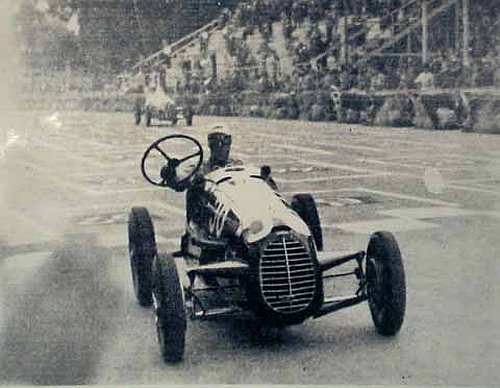
Varzi switched on his lights as he descended to flat country towards Peschiera. By this time the young champion had fought off all competitors after a gruelling race, even though they included such names as Campari, Caracciola, Arcangeli, Ghersi, etc. Only one man remained to be disposed of: Tazio Nuvolari. Varzi had managed to throw him off at Perugia and, as Nuvolari’s car was exactly the same as his own, he had nothing to fear as regards engine power.
Only by some crazy stunt could Nuvolari pull it off; from Perugia to Bologna he gradually gained on Varzi, however, and glimpsed in the uncertain light the shadowy form of his car. At this juncture all Nuvolari’s fearless but calculated daring was now revealed in full. He knew that once Varzi was aware of his closeness there would be no catching him, and so daredevil surprise tactics were the only possible solution. But neither Varzi nor his mechanic, all intent on negotiating the winding dark roads, were aware of the slinky shadow tailing them only a few hundred yards away: the crackling exhaust note and wind noises damped all other sounds.
By now the two cars were tearing along the flat roads, the speedometer needle soaring rapidly from 60 to 100mph, to touch at times 120mph. Varzi still ahead with headlights on, and Nuvolari five hundred yards behind in the dark, his only guide being the light from Varzi’s car. Death stalked the fearless Tazio at every bend, bridge and crossroads; his mechanic, Guidotti, crouched fearful but fascinated by this extraordinary man who seemed to possess the eyes of a lynx and the audacity of a thwarted tigress. Nuvolari sneaked closer and closer to Varzi, who, still oblivious of the threat in the rear and feeling more than ever that victory within his grasp, slowed down somewhat.
Then it happened. Nuvolari jabbed the accelerator flat to the boards, rapidly closing the gap separating the two cars. Varzi, a moment before lulled in a sense of secure victory, was rudely jolted into action as Nuvolari suddenly switched on his headlights and drew level; he stamped on his accelerator pedal in a desperate attempt to throw off the attack, but in vain: Nuvolari tore past at a terrific clip. The finishing line was by now only a few kilometres away and Varzi gave up all hope of victory. Thus Nuvolari won the Mille Miglia. More than beating his rivals, he beat death itself; for him this continued gamble with death was the rule of his sporting life. But his was no foolhardy recklessness, but a cool and calculated audacity born of an invincible passion for every activity which carried the elements of danger in it.
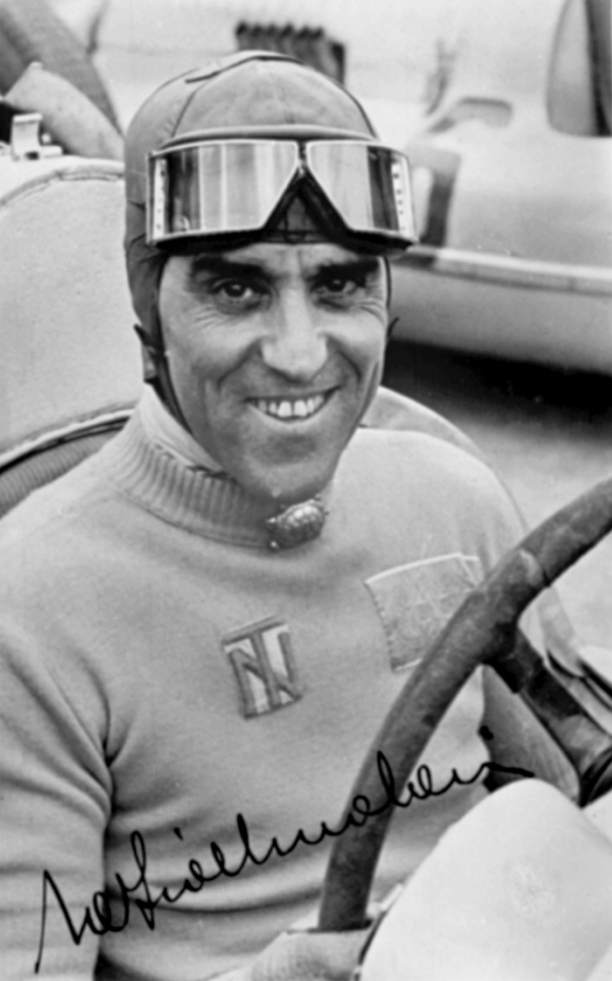
1912, when he was twenty (he was born November 16, 1892, at Casteldario, near Mantova), he saw a dismantled Bleriot aeroplane in a big factory in Milan. He promptly bought it for about two thousand liras (about £20 in those days), and had it shipped to Casteldario. Nobody was surprised when it arrived in the village; they all knew the offspring of Nuvolari pere as “the son of the devil” (il figlio del diavolo) on account of the many and varied dangerous exploits he indulged in with bicycles, horses, motorcycles and finally cars. They were not at all surprised when they saw him assembling the old aeroplane. With the help of a friend it did not take the tireless Tazio long to complete the work. But when it came to flying it, the thing just wouldn’t leave the ground.
Nothing daunted, Tazio rigged up some kind of hoist, and up went the plane right onto the roof of his house. After fixing it with a rope he started up the engine and when he thought the necessary number of revs had been reached he signalled his friend to cut the moorings. Father Nuvolari, used to his son’s crazy exploits, calmly watched the proceedings, cigar in mouth, and muttered: “I just want to see if he makes it.” Did Tazio take off? No, the engine coughed a few times as the Bleriot slipped off the roof and fell smack onto a haystack down below.
The petrol caught fire and the haystack became a raging inferno. The watching crowd surged forward. Nuvolari pere alone didn’t move but continued to puff on his cigar. Presently out came Tazio unhurt and unconcerned. “It was my father who taught me never to be afraid,” said Nuvolari later on to his biographers. “When I was five I was badly kicked by our horse. Three or four days later father threw a silver coin between the horse’s legs and told me to pick it up and keep it for myself. I got it all right, and the horse didn’t move. This was my very first lesson never to fear danger and to tell you the truth I have never known the meaning of fear.”
In 1925, during the Grand Prix of Monza, he wet off the track with the famous P-2 Alfa and was badly smashed up. Diagnosis ordered a month’s detention in hospital. But, as earlier in the year he had signed on with the Bianchi firm to race exclusively their motorcycles, he had been at great pains to get a temporary release in order to compete at the Monza Grand Prix. Not wishing to disappoint the Bianchi people, he left his bed on the fourth day, to the consternation of his nurse and the indignation of his doctor. Trussed up as he was with bandages he couldn’t move a step, let alone bend down. He certainly could not mount a motorcycle in that straightjacket condition.
As ever, Tazio was full of resources. He called the head doctor of the hospital and after many and varied explanations, accompanied by a few deft sketches, he explained the exact position his body must take on a racing motorbike. “Now please do me the favour of undoing all these bandages and then do them up again in this position.”
After some considerable hesitation the doctor complied in the face of such determination, commonly called “guts”. After being trussed up like a mummy he was loaded into a car and conveyed to the Monza track on the day of the great race, where he was bodily lifted onto his Bianchi racing bike. A few friendly cracks about this being “a mummy’s race” and he was off with a broad grin on his face. The grin was a forerunner, for the “mummy” won the gruelling race of 200 miles at an average speed of 80mph. In 1927 he crashed again, in the motorcycle race at Stuttgart; knocked unconscious, the world press announced the loss of the great champion. But he wasn’t dead; just a few fractures and concussion.
Diagnosis ordered a month in hospital once again, but seventy-two hours afterwards this “son of the devil” was on his way back to Italy by train. The same year he crashed again when practising on the Verona circuit, and, believe it or not, trussed up in bandages once more, the indomitable “mummy” won the race. Unbeatable on a motorcycle, he now turned his attention exclusively to racing cars. He was equally unbeatable in this field. At Pau, at the Grand Prix de France, his petrol tank caught fire; located as it was at the back of his machine, he was blissfully unaware of the flames, fanned by a 100mph clip. Lap after lap, until finally he grasped the frantic signals from the pits and groundsmen.
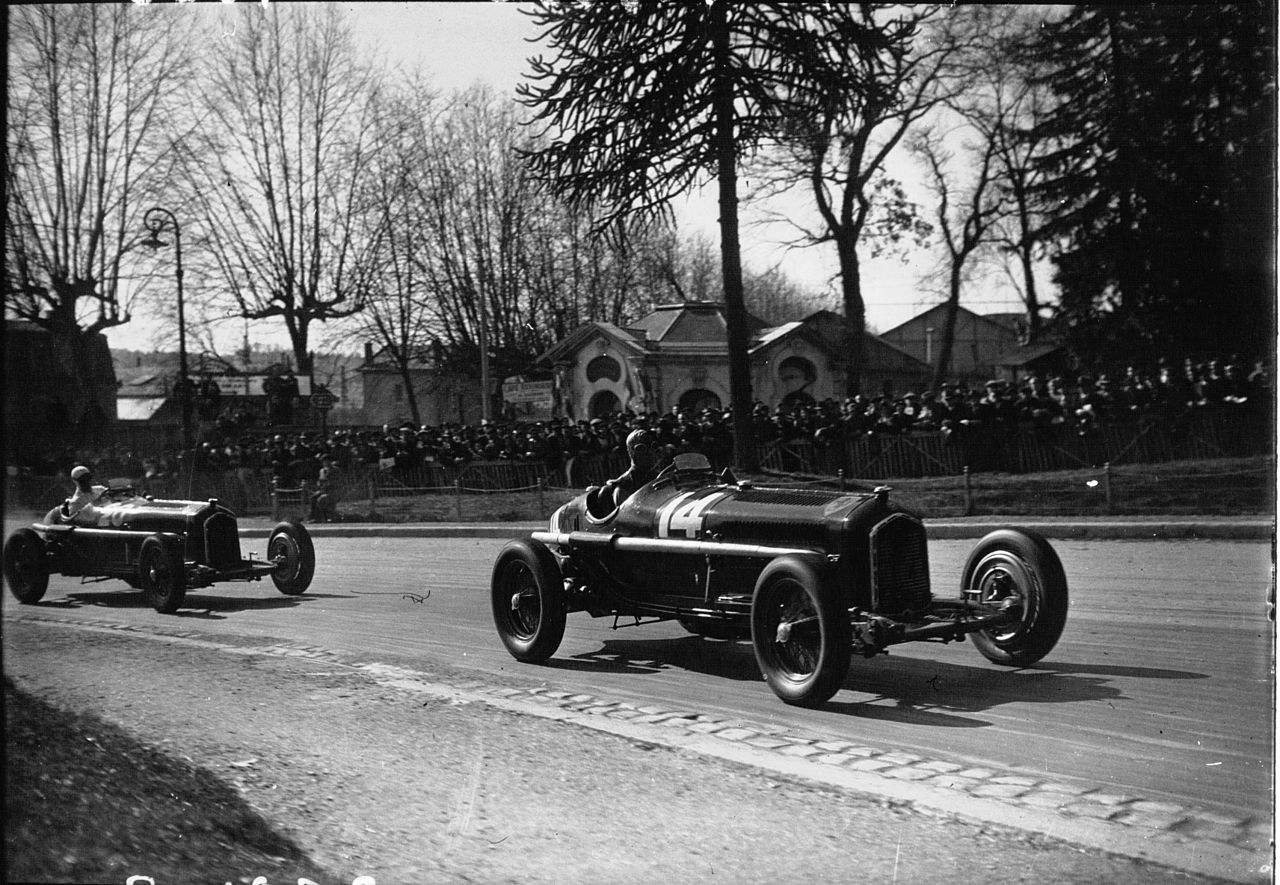
This called for a quick decision: to stop meant envelopment in flames; to continue might endanger the other competitors. This time it really seemed that Death had caught up with him. Once again he gambled. Driving his car towards a grassy patch on the course, he jumped out at 100mph. The car wrapped itself around a tree, and the “devil’s son” was picked up with some broken bones and the usual concussion (the fifth of his career!). But after twenty days he was up again and racing. “The valiant never taste of death but once,” said Shakespeare. Nuvolari proved the truth of this.
The name of Nuvolari was on the lips of the motoring world. The Americans went mad about him when he won the Vanderbilt Cup in 1936 – a cup almost as big as himself, for he was only 5ft 6in and weighed about eight stone – and $32,000. The Germans wanted him for the Auto Union cars, then newly appeared with rear engines. The designer Porsche and Nuvolari got together, and after trying out the car, Tazio suggested certain modifications. At the end of a banquet at which were present the German aces Caracciola, Lang, von Brauchitsch, Rosemeyer and others, Porsche defined Nuvolari as “the greatest champion of the past, present and future.”
Victory after victory were his up to the outbreak of the war with death at his heels. In 1937 he lost a 19-year old son, and another 18-year old in 1943. Then he fell ill himself; exhaust fumes absorbed over a long period had poisoned his whole system. He was warned to stop racing. He laid off for a time but in 1946 was back to win the Albi Grand Prix in a Maserati. This was to be his last great victory. In 1947 he raced again, over the Forli and Parma circuits, but it was no longer the maestro of yore.
The indomitable courage was still there, but his physical strength was undermined by now. Finally, in the same year he was on the point of winning his third Mille Miglia when a terrific storm literally swamped his engine and brought him to a standstill at the doors of Brescia. He came in second, got out of his car, and collapsed. In 1948 he tried a comeback and was well ahead of all competitors when he just had to stop, physically exhausted. He just couldn’t keep going. Did he give up? No, once more, in 1950, he scored a last success as the Monte Pelligrino-Palermo circuit.
And now death has won the last round; it took him unawares, and this time he simply couldn’t fight back. On the border of the Great Road of Life the glorious old machine has stopped forever: the engine died on him, and all around is silence.
Nuvolari won among others 22 Grands Prix including Monaco and the German Grand Prix; The Mille Miglia twice; the Vanderbilt Cup; The Targa Florio twice and the 24 Hours of Le Mans. From 1924 to 1938 he won altogether 49 races.