
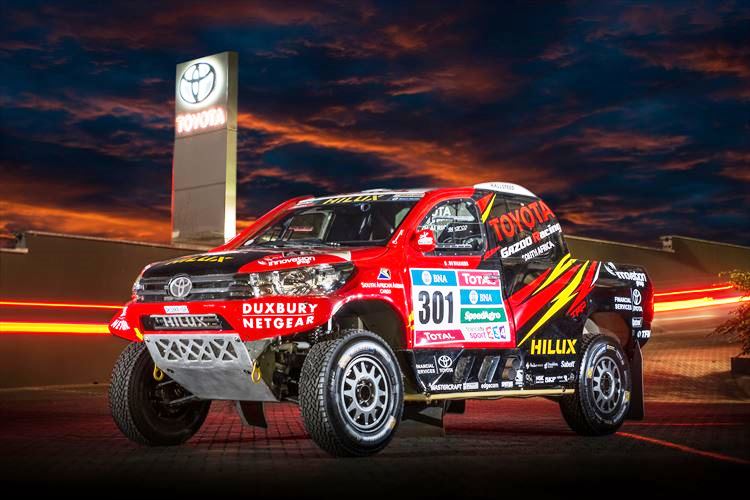
Toyota SA Motors has announced the team that will tackle to 2016 Dakar Rally, which takes place from January 2nd to 16th in Argentina and Bolivia. The race, often billed as the toughest motorsport event in the world, will see three race Toyota Hilux vehicles from South Africa take part under the new team name of Toyota Gazoo Racing SA.
The new name reflects a global move by the Toyota Motor Corporation (TMC) to unify its racing efforts, and will be expanded to include more racing formulae during 2016. The word ‘Gazoo’ has a long and proud history in Japan, and is synonymous with driving pleasure, fun and racing excellence.
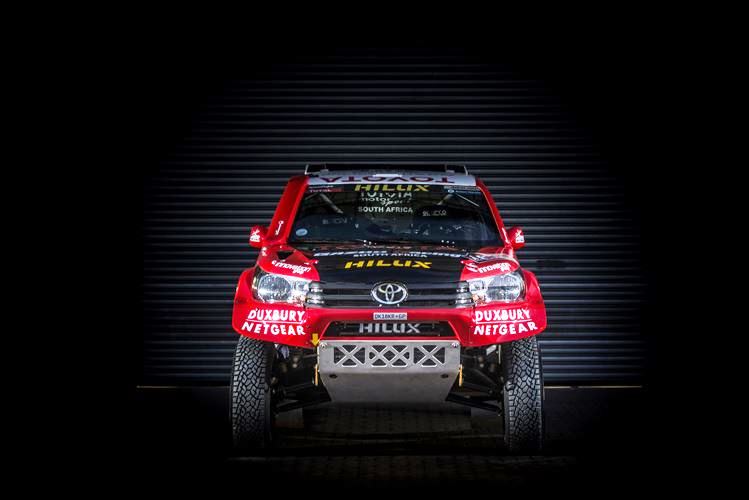
For 2016, the new name will be proudly displayed on the three race Toyota Hilux vehicles that will compete at Dakar. These vehicles will be the New Generation Hilux which debuts in South Africa during February 2016. The latest evolution of the locally developed and built race Toyota Hilux features a new engine and transmission, with many refinements to the suspension and electronic systems, in addition to the bodywork being aligned with the latest New Generation Toyota Hilux.
These vehicles will be crewed by Dakar veteran Giniel de Villiers and his long-serving German navigator, Dirk von Zitzewitz; South African Cross-Country champions Leeroy Poulter and navigator Rob Howie; and Saudi racing sensation Yazeed Al Rajhi and German navigator Timo Gottschalk.
Al Rahji and Gottschalk campaigned a privately-entered Toyota Hilux during the 2015 Dakar Rally, and impressed all by running in third place until a technical problem halted their progress. Now, as part of the Toyota Gazoo Racing SA Team, Al Rahji and Gottschalk will enjoy additional support and the expertise of the technical crew on the event.
“It is an exciting time for us,” says Senior Vice President Sales and Marketing, Calvyn Hamman. “We’ve done a lot of development on the race Hilux this year. Now, with a three-car team, we feel that we’re in a better position than ever to take on the Dakar.”
The Argentine capital of Buenos Aires plays host to the start of the 2016 Dakar, on January 2nd, 2016. This is followed by 13 tough stages, stretching away from Buenos Aires and into Bolivia, before turning southwards again to the finish in the Argentine city of Rosario on January 16th, 2016.
The 2016 route was changed as a result of the country of Peru withdrawing from the race. This means that the bulk of the Dakar takes place in Argentina this time, though the stages on the high plains of Bolivia (altiplano) will add the element of extreme altitude to this edition of the race.
“The Dakar remains an amazingly tough race,” says Team Principal of Toyota Gazoo Racing SA, Glyn Hall. “There are many surprises along the way, and winning it is never easy. With that said, the latest evolution of our race Toyota Hilux, together with a highly talented and motivated crew, certainly gives us a great shot at it. But if there’s one thing you can count on at Dakar, it is that there’s no such thing as a ‘sure thing’.”
THE TEAM: EXPERIENCE AND SPEED
The Toyota Gazoo Racing SA team for the 2016 Dakar Rally consists of three crews. Each of the pairings have proven themselves in the past, and there can be no doubt of the talent and commitment of the six men who will pilot the latest evolution of the South African built and developed race Toyota Hilux.
Giniel de Villiers, a former winner of the Dakar, will again be in action with his highly experienced navigator, Dirk von Zitzewitz. The pair has been together since 2007, and handed Volkswagen their first Dakar win with the diesel Touareg in 2009. Since the move to Toyota in 2012, De Villiers and Von Zitzewitz have recorded finishes of 3rd (2012), 2nd (2013), 4th (2014) and 2nd again in 2015.
De Villiers has only finished outside the Top 10 on the Dakar Rally once, back in 2007 when his vehicle suffered an engine fire while in the lead of the race
This makes De Villiers one of the most successful Dakar racers of all time, and a second victory is certainly in his sights.
For Von Zitzewitz, the Dakar journey started back in 1997, when he rode a KTM motorcycle to fifth place overall. In 2002 the German moved from motorcycles to the navigator seat, partnering America’s Mark Miller. Next came a sting with the Volkswagen team, as partner to Robby Gordon in 2005, and Miller again in 2006. He teamed up with De Villiers in 2007, winning the event in 2009, and becoming part of the Toyota family with De Villiers in 2012.
The second crew will feature newly crowned Donaldson Cross-Country champions, Leeroy Poulter and navigator Rob Howie. The pair have competed in two previous Dakar Rallies together, and have built up a strong rapport after many hours together in the Toyota Hilux.
This year saw Poulter/Howie win all but one round of the local cross-country championship, allowing them to secure the 2015 championship with one round to spare. Poulter is also a former South African national rally champion – with high-speed skill that will serve him well on many of the twisty routes of the 2016 Dakar Rally.
A new addition to the Toyota Gazoo Racing SA team is that of Saudi racing sensation, Yazeed Al Rajhi, partnered by the highly experienced Timo Gottschalk. The pair entered a South African-built Toyota Hilux during the 2015 race, and performed extremely well by running in third overall.
Unfortunately, a small technical problem put paid to their charge, and they were forced to retire.
Al Rajhi is a household name in Saudi Arabia, thanks mainly to his prowess as a racing driver. He competes in the World Rally Championship too, and have notched up a number of podium finishes in the WRC2 class. Gottschalk is no stranger to Dakar, having competed there since 2007. He won the event with Nasser Al-Attiyah in 2011, and partnered with Carlos Sainz in the 2013 edition of the race, before joining Al Rajhi in 2015.
CAR 1: Race number 301
Driver – Giniel de Villiers (RSA)
Navigator – Dirk von Zitzewitz (Germany)
CAR 2: Race number 316
Driver – Leeroy Poulter (RSA)
Navigator – Rob Howie (RSA)
CAR 3: Race number 305
Driver – Yazeed Al Rajhi (Saudi Arabia)
Navigator – Timo Gottschalk (Germany)
THE VEHICLE: EVOLUTION OF THE RACE TOYOTA HILUX
“A race vehicle is never finished – you keep evolving it until the flag drops, then you make the best of what you have at that point.”
– Glyn Hall, Team Principal: Toyota Gazoo Racing SA
The Dakar-specification Toyota Hilux has seen significant development over the last five years. The first version was essentially an evolution of the cross-country race bakkie, developed for the 2011 South African Off-Road Championship (as it was then known). Since then, the vehicle has seen constant evolution thanks to an extended testing programme and technological advances. The result is one of the most successful petrol-powered vehicles ever to take part in the Dakar Rally.
Visually the new vehicle has seen the biggest change in its five-year history. The new body shell is designed to reflect the next generation Toyota Hilux, though in the case of the race vehicle the panels are rendered in ultra-lightweight composites, keeping the overall weight down as much as possible. Together with a striking new livery, the 2016 Dakar Toyota Hilux is an imposing beast of a machine.
But while the bodywork and livery might be the easiest changes to spot, the biggest change lies under the bonnet. This year the team will be fielding the all-new Lexus RC-F V8 engine – the most powerful 2UR-series engine ever built.
This new engine sports more efficient combustion and lower friction which, together with a wider degree of cam timing and electric inlet control, offers a significant improvement over the previous engine. With that said, the FIA still imposes restriction in terms of airflow into petrol engines for cross-country racing, and the new engine had to be adapted to make the most of the smaller influx of air into the engine.
“By working with the exhaust system, inlet manifold and engine mapping system, we managed to coax the most out of the engine without compromising its reliability,” says Hall.
The result is a highly flexible, reliable V8 motor that uses new technology such as a combination of direct injection and port injection, to generate in the region of 285 kW of power and over 600 Nm of torque. The torque curve is extremely flat, with most of the torque available from as low as 2,000 r/min, giving the Toyota Hilux the grunt it needs to tackle even the biggest dunes.
A new transmission system is also in place, utilising a new gearbox that has seen significant testing during the 2015 cross-country season. The transmission features a larger centre differential, despite being lighter than the system used in previous years.
For 2016 the Toyota Hilux also features a new Controller Area Network (CAN) electronic power distribution system, which is significantly lighter and more flexible than the traditional wiring harnesses used in the past.
The suspension is one of the components of a race vehicle that can be eternally tweaked and developed. With that said, the 2015 Dakar Toyota Hilux had an exceptional suspension setup, which has largely been carried over to the new version. Further development took place during the year, with major improvements for rally-type stages, as well as off piste sections.
“Overall we are confident that the latest evolution of the Dakar Toyota Hilux is ready to face the 2016 Dakar Rally. Unfortunately we’ll only really know how we stack up to the competition when the race gets going, but we have every reason to be confident,” says Hall.