
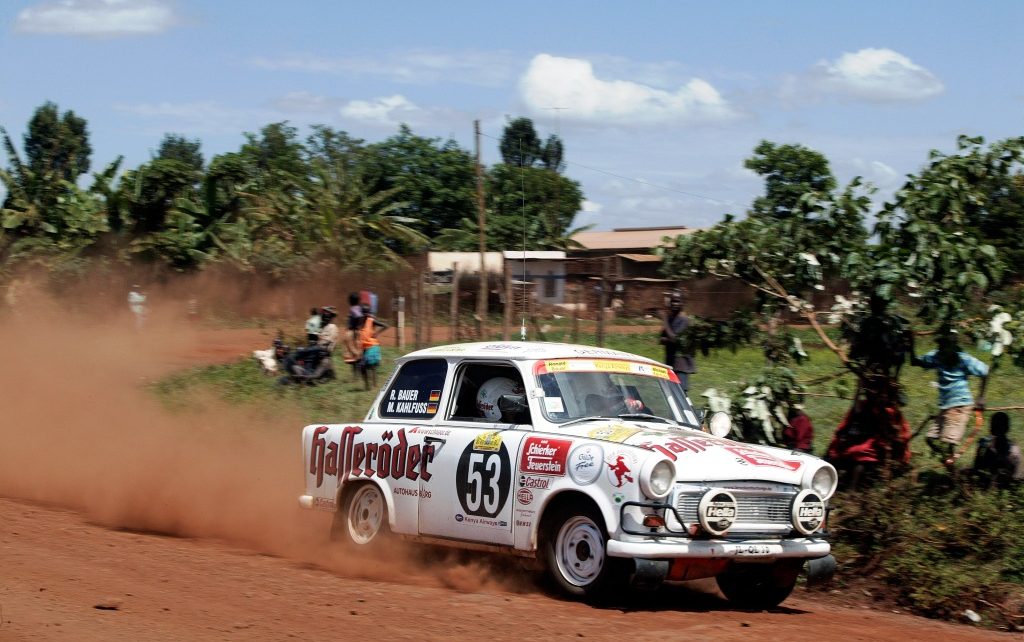
It is often said that rallying is a unique sport. If true, then that is probably because many of the people and cars involved in rallying are also unique. This can be seen clearly on rallies like the Kenya Airways Safari Classic where variety and uniqueness are imporatant features of its entry list.
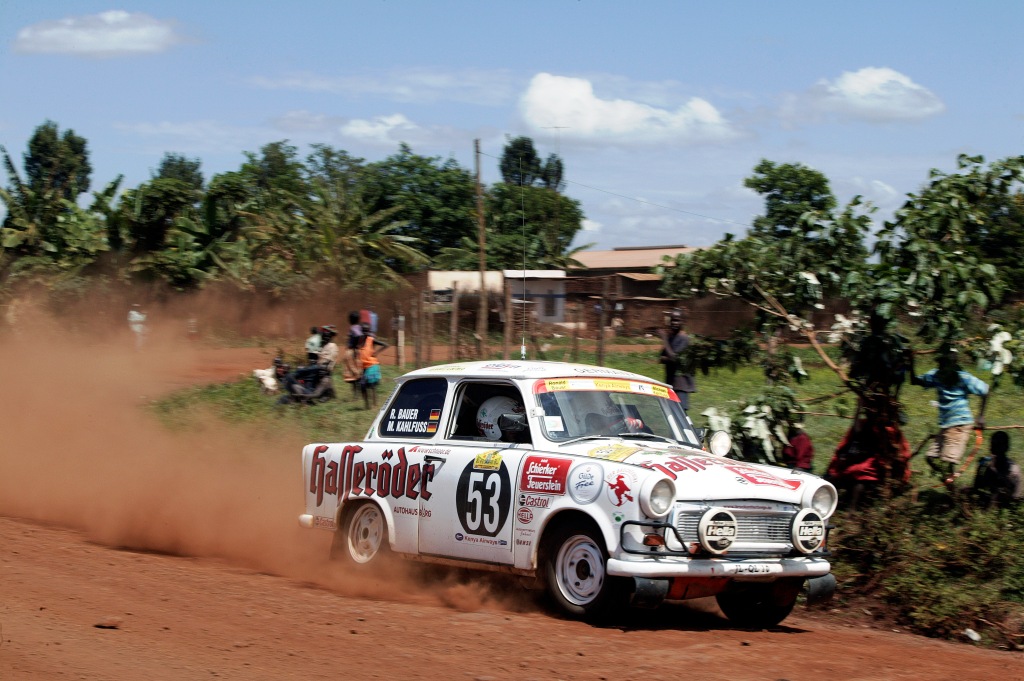
One very good example of this is the Trabant P601 entered on the 2015 Safari Classic by Michael Kahlfuss. When he started motor sport at the age of eighteen in 1981, Germany was still a divided country and he was living in the GDR. In 1983, he started competing on rallies and drove both Ladas and Trabants – two of the few makes of car available to residents of the GDR – in regional and national championships. In 1990, Michael was runner-up in the GDR national championship with a Group A Trabant and it was later that same year that Germany was re-unified. This meant that he was able to travel freely and compete on international rallies.
Naturally his first exploits were with a Trabant and he aimed high. In a period of four years, he drove Monte Carlo Rally, 1000 Lakes Rally, Rally Australia and RAC Rally (twice). He started a motor sport company and soon was able to carry on his globetrotting hobby of driving international rallies with various Group N cars such as a Toyota Celica GT-Four and Mitsubishi Lancer Evos. He nearly always finished and his best overall results were both fifteenth overall, in China (1999) and Mexico (2005) where he also won Group N.
Before that, in 1994, he decided to enter the Safari Rally and built up a Trabant P601 from scratch. With a windscreen header reading “In co-operation with Toyota Team Europe” – TTE had flown his Trabant to Africa in their Antonov freighter – he and co-driver Ronald Bauer got up to twenty-first overall and well into the third leg before problems with the steering put them out. Then in 2003, Kahlfuss entered the first Safari Classic using the same Trabant. With start number 53, he and Bauer got it round the demanding nine-day route and finished thirty-second out of forty-two finishers.
That Trabant was returned to his workshop from Kenya in 2003 but work has started recently to prepare it ready for shipping to Mombasa towards the end of this summer. The 600cc twin-cylinder, two stroke engine gives a modest 50 bhp but the car’s unitary construction and composite bodywork make it a light car, somewhere around 600 kg. This still gives it one of the lowest power-to-weight ratios of the cars entering the Safari Classic but Michael is not downhearted: “We know the car and the rally. I am only afraid of the mountains when we have to drive in first gear for half an hour. Also for the water crossings as, if there is a strong current, the Trabant could float away very easily.”
There is currently a poll running on a website for Trabant enthusiasts where, at the moment, sixty per cent think Kahlfuss, Bauer and their P601 will not make it to the finish of the Safari Classic in November. “I just want to prove them wrong.” says Michael Kahlfuss – and the record of his past performance says that he probably will !